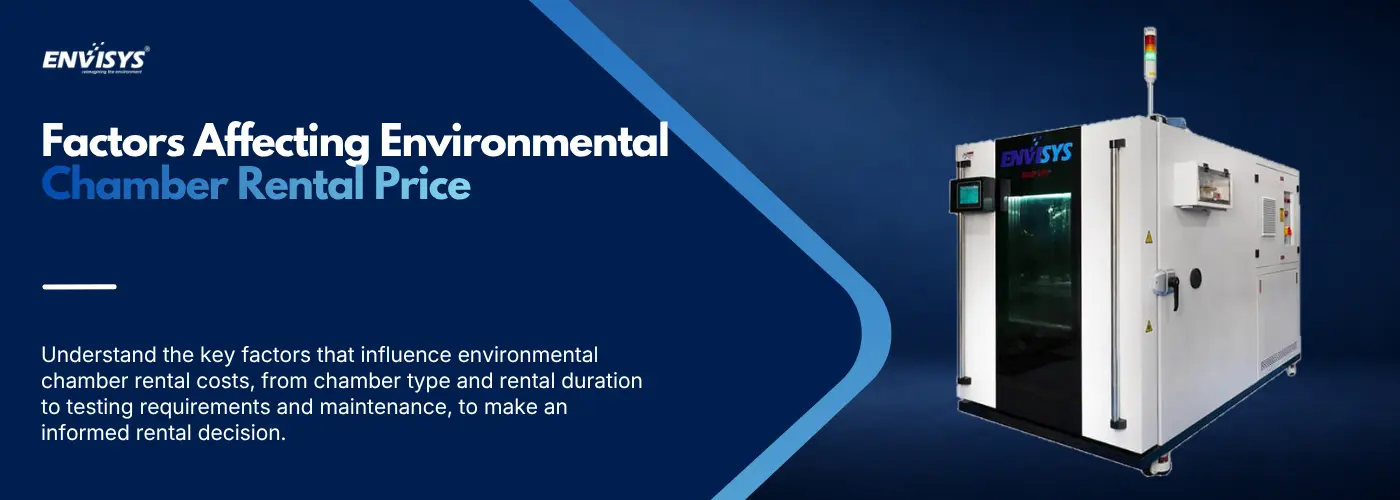
Ask three suppliers to quote an environmental chamber rental and you can get three numbers nowhere near each other. That is not usually anyone being unreasonable. Rental pricing is built from a stack of separate things, and each supplier is making different assumptions about what you need.
The quotes only become comparable once you know what sits inside them. A cheaper rate for a chamber that cannot hold your humidity setpoint is not cheaper. A higher rate that includes transport, commissioning and calibration is often the lower total.
This article breaks down the eight things that move the price, then where you can cut cost without cutting the parts that matter.
Why Companies Rent Environmental Test Chambers
The economics are simple enough. A chamber is a capital purchase with a ten to fifteen year life, and it earns its cost back only if it runs regularly. For a single qualification, a prototype validation or a customer audit, buying means paying for years of capability to use a few weeks of it.
Renting also removes the ongoing costs of ownership. Calibration cycles, preventive maintenance, spare parts, refrigerant servicing and the floor space itself all belong to someone else.
Timing matters too. Buying a chamber can take several months from purchase order to commissioning, which does not help when a customer wants data in six weeks.
Then there is overflow. Companies that already own chambers rent when two programmes need the same unit at once, since a second rented chamber is cheaper than a delayed launch. If you are still working out what capability your test needs, this explanation of environmental test chamber principles, types and uses is a sensible place to start before you request quotes.
8 Main Factors That Affect Environmental Chamber Rental Price
The factors influencing chamber rental price are listed below. Some you control, some you do not, and knowing which is which is where the savings are.
1. Chamber Size and Internal Volume
Size moves the price more than anything else. A benchtop unit and a walk–in chamber are not variations on a theme, they are different orders of cost.
The reason is not just the equipment. A bigger chamber needs a larger refrigeration system and draws more power, which affects your running costs as well as the rate. It needs specialised transport rather than a standard vehicle. It may need rigging to get it into position, and your site has to support the floor loading and the electrical supply. Walk–in units sometimes need assembly on site, which adds days of engineer time to the bill.
2.Temperature and Humidity Range Required
Range costs money, and the cost is not linear. Getting to minus 40°C is routine. Getting to minus 70°C needs cascade refrigeration, which is a substantially more expensive machine to build, run and maintain.
Humidity control adds its own cost, since it needs a steam or atomising system, water supply and drainage. Tight tolerances raise it further, because holding humidity to plus or minus 2% RH takes better instrumentation than holding it to plus or minus 5%.
Ramp rate is the one people forget. A chamber that reaches your temperatures slowly costs far less than one that reaches them in five minutes, and standards often specify the rate.
3. Rental Duration
Daily rate falls as duration rises, and the drop is steep at the short end. Delivery, installation, commissioning and collection cost the provider roughly the same whether the chamber stays a week or three months, so those fixed costs are spread across fewer days on a short rental.
This is why many providers set a minimum period, often a month. It also means the gap between a two–week and a six–week rental is often smaller than you would expect. If your programme might run long, price both upfront, because extending late is usually more expensive than booking the time at the start.
4.Type of Environmental Testing Needed
A steady–state temperature and humidity soak is the cheapest thing you can ask a chamber to do. Everything beyond it costs more.
Thermal cycling needs faster ramp rates and a refrigeration system built for repeated swings. Environmental stress screening pushes that further. Battery testing carries a significant premium, since the chamber needs gas detection, pressure relief, controlled venting, fire suppression and construction that can contain a thermal event, and providers price in the risk of the specimen failing badly.
Combined testing raises the price again. A chamber integrated with a shaker, or one that also controls pressure, is a more complex machine with a smaller rental pool behind it.
5. Chamber Availability and Urgency
Availability is the factor that most often surprises people, because it has nothing to do with the chamber’s specification.
If a suitable unit is sitting idle, you get a normal rate. If everything suitable is booked, the provider is either sourcing from elsewhere or turning down other work to serve you, and the price reflects that. Urgent delivery adds expedited transport, out–of–hours engineer time, and sometimes rush calibration.
Timing is seasonal too. Quarter ends and the run–up to certification deadlines are busy across the industry. Booking six weeks out rather than six days out is one of the largest savings available to you, and it costs nothing.
6. Installation, Shipping, and Site Requirements
Transport is charged both ways and scales with distance and chamber size. A provider two hours away is materially cheaper than one across the country before you compare anything else.
Installation costs depend on what your site needs. If the chamber rolls through a door and plugs in, the cost is small. If it needs rigging, a crane, or a three–phase supply that has to be run, the cost is not small. Site preparation is normally yours to arrange: floor loading, doorway and corridor width, power supply and phase, drainage if the chamber needs it, and clearance around the unit.
Site checks that get skipped turn into failed deliveries, and a wasted delivery is charged to somebody.
7.Technical Support and Maintenance Coverage
Support is where quotes diverge most and where comparing daily rates misleads you. One provider includes commissioning, operator training, preventive maintenance, calibration and a committed response time. Another delivers the chamber and leaves.
The second looks cheaper until something fails. A chamber down for four days in the middle of a six–week programme can cost more than the entire rental. Ask what response time is committed, who pays for repairs, whether a replacement unit is available, and whether calibration during a long rental is covered. Providers whose service operations already handle installation, commissioning and calibration tend to price support into the rate rather than treating it as an extra.
8. Chamber Brand and Technology Features
Newer chambers with modern controllers cost more to rent than older units, and sometimes that premium is worth paying.
Programmable multi–step profiles, data logging with clean export formats, remote monitoring, and faster ramp rates all raise the rate. Whether they earn it depends on your test. Remote monitoring genuinely pays for itself on long overnight soaks, since a fault at 3 a.m. that nobody sees costs you the whole cycle. Advanced profiling matters if your standard specifies a complex sequence and is wasted if you are running a flat soak.
Brand carries a premium too, and it is worth asking whether it buys performance or just a name.
How to Reduce Environmental Chamber Rental Costs
Start by writing the specification from your test standard rather than from a wish list. Overspecified range, tolerance and ramp rate are the most common source of an inflated quote, and providers cannot trim what you have asked for.
Size honestly. Measure the specimen with its fixture and cabling, add clearance, and rent that. Renting larger than necessary costs more in rate, transport and installation.
Book early. Advance booking is the single largest saving available and it costs nothing but planning.
Look locally first, since transport both ways scales with distance.
Bundle your testing. If two programmes both need chamber time, running them in one rental period beats two separate mobilizations.
Price the extension upfront if there is any chance the programme runs long.
And compare totals rather than daily rates. Add transport both ways, installation, commissioning, calibration, training, support and collection to each quote, then look again at which one is actually cheapest.
Conclusion
Environmental chamber rental pricing factors come down to what you are asking the chamber to do, how long you need it, how urgently, and how much support comes with it. Size and capability set the base, duration and timing move it substantially, and support decides whether the rental works.
The practical takeaway is that you control more of this than it first appears. Specifying accurately, booking early and comparing full costs rather than daily rates will do more for your budget than negotiating hard on the rate itself.
FAQs
- What is the average environmental chamber rental cost?
There is no meaningful average, because the range is too wide for one to be useful. A small benchtop humidity chamber and a walk–in thermal cycling chamber differ by a large multiple, and the same unit prices differently over one week versus three months. Ask for a quote against your actual specification covering the full period including transport, and treat any figure quoted without seeing your requirement as a rough
guess.
- Why do environmental chamber rental prices vary so much?
Because a quote is built from several independent things: chamber size, temperature and humidity capability, ramp rate, test type, rental duration, urgency, transport distance, and what support is included. Two suppliers quoting the same chamber can differ largely because one has included commissioning, calibration and technical support while the other has quoted equipment only.
- Does chamber size affect rental pricing?
Yes, and it is usually the biggest single factor. Larger chambers need bigger refrigeration systems, draw more power, cost more to transport, and often need rigging and site preparation. Size your rental to the specimen plus its fixture and the clearance needed for airflow, and no larger.
- Is long–term environmental chamber rental cheaper?
Per day, almost always. Delivery, installation, commissioning and collection cost the provider much the same regardless of duration, so those fixed costs spread thinner over a longer period. That does not make a long rental cheaper overall than a short one, so book the time you need rather than the time that looks efficient on a rate card.
- What hidden costs should I check before renting a chamber?
Return transport, since some quotes cover delivery only. Calibration before dispatch or during a long rental. Installation, rigging and site preparation. Operator training. Charges for extending or returning early. Liability for repairs and what counts as normal wear. Ask for these in writing, because these environmental chamber rental quote factors are exactly what separates a low rate from a low total.