A battery pack in an Indian city sits in 45°C heat all afternoon, then charges fast enough to add its own heat on top. In a Himalayan winter the same pack has to deliver current at minus 20°C. Across its life it will also see monsoon humidity and road vibration.
Each of those changes how a lithium cell behaves. Heat accelerates degradation and, past a point, sets off reactions that do not stop. Cold slows the chemistry and reduces capacity. Humidity attacks connections, and vibration works fasteners loose.
The consequences are also more serious than with most components. A failed battery does not simply stop working. It can vent, catch fire and take a vehicle with it, which is why battery testing is more rigorous and more carefully contained than almost any other automotive qualification.
What Is Automotive Battery Environmental Testing?
Automotive battery environmental testing subjects cells, modules and complete packs to controlled stress while their electrical behaviour is monitored, so failures happen in a laboratory rather than in service.
The chamber reproduces the condition: temperature, humidity, pressure, vibration, or several at once. A battery cycler charges and discharges the battery throughout, because an idle battery behaves nothing like a working one, while instrumentation records cell temperatures, voltages, capacity and internal resistance.
The automotive battery environmental testing process runs at three levels. Cell level characterises the chemistry. Module level checks how cells behave grouped together, where thermal interaction between neighbours matters. Pack level validates the complete assembly with its housing, cooling and management electronics, which is the only level that shows how the finished product performs.
Why Environmental Testing Is Critical for Automotive Batteries
The first reason is safety. Lithium–ion cells store a great deal of energy in a small space, and thermal runaway releases it rapidly along with flammable gas. Lithium ion battery automotive testing establishes the boundary between safe operation and failure, and confirms safety systems intervene when they should.
The second is that degradation is invisible until it is not. A cell losing capacity through repeated high–temperature cycling shows nothing externally, and accelerated testing surfaces that decline early enough to change the design.
Third, warranties depend on it. Manufacturers commit to capacity retention over years, and accelerated validation is the only way to support that beforehand. Fourth, regulation requires it: lithium battery environmental validation is a condition of market access rather than an internal quality choice.
Key Environmental Tests Performed on Automotive Batteries
Different conditions attack batteries differently, so most programmes run several.
1. Temperature Cycling Test
The battery ramps repeatedly between hot and cold extremes with dwells at each end, typically minus 40°C to plus 85°C, over hundreds of cycles.
This is the core of automotive battery thermal testing. Repeated expansion and contraction stresses cell seals, welded tabs and busbars, while the chemistry degrades faster under thermal stress. Capacity and internal resistance are measured at intervals.
2. Thermal Shock Test
Rather than ramping, the battery transfers between separately conditioned hot and cold zones in seconds, so the surface changes temperature far faster than the core and stress concentrates where materials meet. Shock finds different defects from cycling: weak welds, marginal seals, and voids in potting that gradual change never exposes.
3. High–Temperature Aging Test
The battery is held at elevated temperature, often 45°C to 60°C, while being cycled or held at a state of charge. Heat accelerates the side reactions that consume lithium and thicken the electrode interface layer, so weeks at temperature approximate years of use. This is how capacity fade predictions get made.
4. Low–Temperature Performance Test
The battery is cooled, often to minus 20°C or minus 40°C, then asked to deliver and accept current. Cold slows ion movement, so capacity drops and internal resistance rises sharply. Charging matters most: charging a cold lithium cell risks plating metallic lithium on the anode, permanently damaging it and creating a hazard. This test establishes what the battery management system must prevent.
5. Humidity Resistance Test
The battery is held at high humidity, commonly 85% RH at 85°C, sometimes with condensation cycles. Moisture corrodes terminals, degrades insulation, and can create leakage paths between the pack and the chassis. Insulation resistance is measured throughout, since a falling value warns of a developing fault.
6. Vibration Testing
The battery is mounted on a shaker and run through road profiles, often for many hours across all three axes. Vibration fatigues weld joints and busbars, loosens fasteners, and wears insulation where components rub. Mechanical shock testing usually accompanies it for potholes and kerb strikes.
7.Altitude/ Pressure Simulation Test
Pressure is reduced to simulate altitude, commonly to 11.6 kPa for six hours as UN 38.3 Test 1 requires. Low pressure stresses cell seals from the inside, revealing weak crimps or welds as leakage or venting. Anything shipped by air needs this first.
8. Combined Environment Testing
The realistic version. Temperature and vibration run simultaneously, or temperature with humidity or altitude, while the battery is cycled throughout. Combined testing finds failure modes sequential testing misses, because a weld that survives vibration at room temperature can fail when the same vibration arrives at minus 30°C.
Common Failure Modes Detected During Testing
Capacity fade is the most common: the battery holds less charge than when new, and the test establishes how quickly. Internal resistance growth follows, cutting available power and generating more heat for the same current, which accelerates further degradation.
Cell swelling appears under high–temperature or overcharge conditions as gas builds inside the cell, stressing the housing and disturbing spacing. Seal and weld failures show up as electrolyte leakage or loss of contact after thermal shock or vibration, and loosened connections cause intermittent faults and localised heating.
Insulation breakdown emerges from humidity and thermal stress, which matters greatly in high–voltage packs. Cell imbalance develops when cells age unevenly, usually because one sits in a hotter part of the pack.
Then the serious ones: venting and thermal runaway. Testing establishes what triggers them and verifies that containment and shutdown systems respond.
Automotive Battery Testing Standards to Know
UN 38.3 governs transport and applies to every lithium battery shipped, covering altitude simulation, thermal cycling, vibration, shock, external short circuit, impact, overcharge and forced discharge.
IEC 62660 covers lithium–ion cells for electric vehicles across performance, reliability and abuse testing. ISO 6469 addresses electric vehicle safety including the energy storage system, and ISO 12405 methods remain widely referenced for pack testing. For product safety, IEC 62133 and UL 2054 are the common references, and SAE J2464 covers abuse testing. UNECE R100 governs vehicle approval in many markets, AIS 156 applies in India and GB 38031 in China.
Above these sit OEM specifications, usually stricter than any published standard. Confirm which document governs your programme before specifying equipment, since it determines the chamber capability you need.
How to Choose the Right Battery Environmental Test Chamber
Safety architecture matters more than temperature range, which is the opposite of how most chambers get compared. A battery chamber needs explosion–resistant construction, gas detection for hydrogen, carbon monoxide and hydrocarbons, pressure relief, automatic air exchange, fire suppression, and door interlocks that hold the door closed during a fault rather than releasing it.
Beyond safety, check temperature and humidity range against your standard, and ramp rate, since cycling standards specify how fast transitions occur.
Then check integration. The chamber needs cable pass–throughs sized for cycler connections and communication interfaces so environmental and electrical data land on one timeline. Without that, correlating a voltage event to a temperature event is guesswork.
Size for the specimen you will test in two years. Cell–level chambers are small; pack–level work needs far more volume. Finally, ask what happens on a power failure mid–test and what the service response time is.
How Envisys Supports Automotive Battery Testing
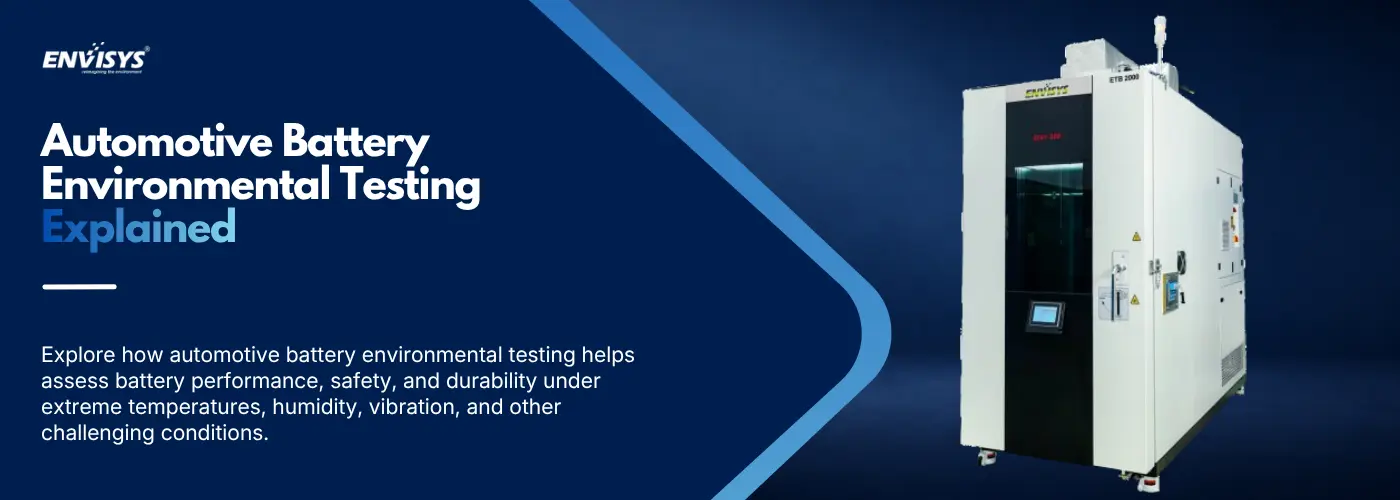
Envisys builds battery testing chambers specifically for cell, module and pack validation rather than adapting general climatic chambers to the job.
The chambers cover a wide temperature range with humidity control from 10% to 98% RH, plus altitude capability for transport testing. Safety is layered around EUCAR hazard levels: gas detection for carbon monoxide, oxygen, hydrogen and hydrocarbons, CO2 fire suppression, automatic air exchange, pressure relief ports, and mechanical door locking that prevents opening mid–test. Alarms cover door opening during test, smoke detection, insulation faults, over–temperature and safety PLC conditions.
Cable pass–throughs with RS–232, RS–485 and Ethernet interfaces let the chamber synchronise with external cyclers, so environmental and electrical data are captured together. Configurations run from small chambers for cell characterisation to walk–in designs for complete packs, including dual stack battery test chambers where two independent test spaces are needed without doubling the floor area. Chambers can be configured for the requirements referenced in standards including UL 2054 and IEC 62133, with installation, commissioning and calibration handled directly.
Final Thoughts
EV battery environmental testing is not a box to tick before launch. It is how manufacturers establish that a pack will hold its capacity, deliver power in the cold, survive years of vibration and heat, and fail safely if it fails at all.
The testing is demanding because the failure mode is serious, which also means the equipment matters. A chamber that cannot contain a venting cell or purge the gas it releases is not suitable regardless of its temperature specification. Start from the standard your programme must satisfy, specify the chamber around it, and treat safety architecture as the first requirement rather than an option.
FAQs
- What temperature range is used for automotive battery testing?
Most work runs between minus 40°C and plus 85°C, covering cold–climate starting through to extreme heat plus the battery’s own heat under load. High–temperature ageing typically holds 45°C to 60°C for extended periods, and abuse testing can extend wider. The governing standard sets the extremes, so work from that rather than chamber capability.
- Which standards apply to automotive battery environmental testing?
UN 38.3 for transport, IEC 62660 for EV lithium–ion cells, ISO 6469 for electric vehicle safety, IEC 62133 and UL 2054 for product safety, and SAE J2464 for abuse testing. UNECE R100 governs vehicle approval in many markets, AIS 156 applies in India and GB 38031 in China, and OEM specifications are usually stricter than any of these.
- Can automotive battery testing include vibration and humidity together?
Yes, and combined testing is increasingly standard because it reflects reality. Temperature with vibration is the most common pairing, since a weld that survives vibration at room temperature may fail at minus 30°C. Temperature with humidity is routine, and temperature with altitude covers transport work.
- What safety features should a battery test chamber have?
Explosion–resistant construction, gas detection for hydrogen, carbon monoxide and hydrocarbons, pressure relief ports, automatic air exchange to purge vented gas, fire suppression, and mechanical door locking that keeps the door shut during a fault. Alarms should cover over–temperature, insulation faults and door opening during test, with power to heaters cut automatically when a fault is detected.

