At sea level, air does a lot of quiet work for you. It carries heat away from a hot component and presses on a sealed enclosure at the force that enclosure was designed for.
Take the air away and things behave differently. A power supply that ran cool on the bench overheats because convection has stopped. A battery cell swells. An adhesive releases vapour onto a nearby lens.
None of this shows up in normal testing. It shows up at 30,000 feet in a cargo hold, in a satellite payload bay, or on a vacuum coating line. That is why manufacturers put products through a vacuum environment test chamber first. Chambers vary widely though, and the differences matter more than most first–time buyers expect.
What Is a Vacuum Environment Test Chamber?
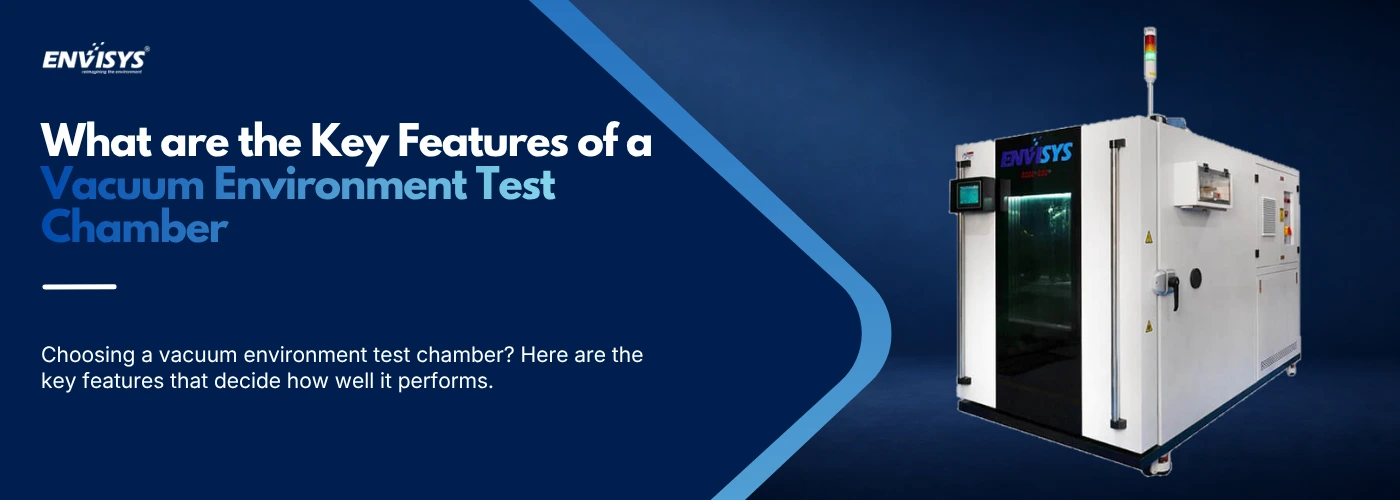
A vacuum environment test chamber is a sealed enclosure connected to a pump system that removes air until internal pressure drops well below atmospheric. The product sits inside while pressure comes down, and instrumentation records what happens.
Depending on the pump setup, a chamber might hold anything from a mild partial vacuum to a very deep one. Drop to around 190 mbar and you have replicated conditions at roughly 12,000 metres, which covers most altitude simulation. Go below 0.001 mbar and you are into space simulation and outgassing work.
Most industrial vacuum testing chamber work also involves temperature. Products in the field meet low pressure and heat or cold together, so a chamber that does both at once gives a more realistic picture.
Why are the Features of a Vacuum Chamber Crucial?
A chamber is not a passive box. Its construction and controls decide whether your results are worth anything.
Accuracy comes first. If the chamber cannot hold a stable pressure, you cannot tell whether a change in the specimen came from the test condition or the equipment. A slow leak that pushes pressure up a few millibars over an eight–hour soak invalidates the run.
Compliance is second. Standards like RTCA DO–160, MIL–STD–810 and IEC 60068-2-13 specify pressures, ramp rates and hold times. If the chamber cannot reach the pressure or hold the rate, you cannot claim the test.
Safety is third. A vacuum chamber holds a serious pressure differential across its walls, and if the specimen is a lithium battery, the failure mode inside is not gentle. Vacuum chamber safety features are not an upgrade you add later.
Key Features to Look for in a Vacuum Environment Test Chamber
Ten things to press on when comparing quotes. Some appear on every datasheet. Others you have to ask about.
1. Vacuum Pressure Range
Everything else follows from this. Ask what the lowest achievable pressure is, and separately what pressure the chamber holds steady through a long soak. Those are different numbers.
For altitude simulation on avionics, automotive parts or packaging, a range down to roughly 1 mbar is usually enough. Outgassing and space work needs far deeper vacuum, often below 0.001 mbar. Extra range adds cost, so match it to your standards rather than to the impressive number.
2.Chamber Size and Internal Volume
The specimen has to fit, but it also needs space around it. Pack a chamber tightly and airflow gets blocked, temperature turns uneven, and pump–down takes longer.
A common mistake is sizing for today’s product. Chambers last fifteen years and products grow. Check internal dimensions against your largest likely specimen plus its fixture and cabling, and check the door opening.
3. Temperature Control Capability
Most real failures happen when low pressure and temperature stress arrive together, and a vacuum chamber with temperature control reproduces that.
Verify two things. First, whether the temperature range holds across the whole pressure range, since cooling behaves differently where convection cannot move heat. Second, how heat reaches the specimen. Under deep vacuum, chambers use conduction through a controlled platen or radiation from shrouds. One relying purely on circulating air will not hold temperature once you pull a hard vacuum.
4. Leak Detection and Chamber Sealing
Sealing is the difference between a chamber that works in year one and one that still works in year ten. Look at the door seal design, its material, and how easy it is to replace.
Ask for a leak rate specification, expressed as pressure rise over time with the pump isolated. Check that feedthroughs for thermocouples, power and signal cables are proper sealed fittings, because that is where most field leaks begin.
5. Vacuum Pump Performance
The pump decides how fast you reach pressure and whether you stay there. Rotary vane pumps are common, economical and fine for rough vacuum, but oil vapour can migrate back into the chamber and contaminate sensitive specimens. Dry scroll pumps avoid that at higher cost, and deep vacuum needs a second stage such as a turbomolecular or diffusion pump.
Ask for pump–down time to your working pressure with a realistic load inside, not an empty chamber. Ask about maintenance too, since oil changes and seal replacement rarely appear in the quote.
6. Monitoring and Control System
A controller should let you build a multi–step profile: ramp to a pressure at a set rate, hold, change temperature, hold again, return to ambient. Once written, it should run identically every time, which is what makes results comparable between months.
Check the pressure sensor type and its accuracy across your working range, since one gauge rarely covers rough and high vacuum well. Look for alarm setpoints, abort conditions, and remote monitoring for overnight runs.
7.Material Construction and Durability
Chamber walls carry the full atmospheric load pressing inward, around ten tonnes per square metre. Stainless steel is standard for the inner shell, with 304 common and 316 where corrosive vapours or salt are involved.
Material choice also affects results. Some materials outgas, raising the chamber’s base pressure and contaminating the specimen, which matters most in optical and space work. Check the internal finish too, since a smoother surface pumps down faster.
8. Safety Features
Reasonable protection includes a door interlock that prevents opening under vacuum, pressure relief on the venting path, and over- temperature cutouts independent of the controller.
If you test batteries or anything that can vent, you need more: gas detection, an exhaust route that does not lead into the lab, and construction that can contain a thermal event. Ask what happens on a power failure mid–test, since an uncontrolled vent damages specimen and chamber alike.
9. Data Logging and Test Reporting
If a result is not recorded, it did not happen as far as an auditor is concerned. The chamber should log pressure, temperature and specimen channels at an interval you set, with timestamps and a record of which profile was running. Check the export format, because a proprietary file you cannot open outside the supplier’s software becomes a problem five years on. Look for reports showing the actual profile against the target.
10. Customization and Testing Flexibility
Very few vacuum test programmes fit a catalogue chamber exactly. You might need extra feedthroughs for a battery cycler, a window positioned for a camera, or a fixture holding a part at an angle.
Envisys Technologies builds altitude and vacuum systems around the specimen rather than the other way round, including vacuum degassing and outgassing chambers used to remove trapped air from resins and potting compounds. Find out early whether a supplier engineers to a drawing or only configures a fixed platform.
How to Choose the Right Vacuum Environment Test Chamber
Work backwards from the test, not forwards from the catalogue.
Write down the standards you must satisfy and pull the pressure, temperature, ramp rate and hold time from each. Measure your largest specimen with its fixture. Decide whether you need temperature simultaneously or only sequentially, since combined capability costs more. Count the instrumentation channels passing through the wall.
Then ask suppliers to quote against that document rather than a general enquiry, because the technical response tells you a lot. Ask about lead time, commissioning and calibration, and where the nearest service engineer is. A chamber idle for three weeks waiting on a part is expensive in ways the purchase price never shows.
Industries That Commonly Use Vacuum Environment Test Chambers
Aerospace and aviation are the largest users. Avionics, cabin equipment, seals and fluid systems get qualified against DO–160 or MIL–STD–810 altitude profiles before flight. Defence programmes test equipment carried on aircraft or deployed at elevation.
Battery and EV manufacturers use altitude testing for transport certification under UN 38.3. Electronics manufacturers test enclosures, connectors, displays and power supplies, mainly for thermal behaviour once convective cooling is gone. Space and satellite work uses deep vacuum for thermal vacuum testing and outgassing characterisation against standards such as ASTM E595.
Medical device makers qualify equipment that travels by air, and materials labs use vacuum chambers to degas resins, adhesives and potting compounds where trapped air would cause voids.
Conclusion
The vacuum test chamber features that matter most are the ones tied to your actual standards: the pressure you need to reach and hold, whether temperature comes with it, how the chamber is sealed, and what the pump sustains over a long soak.
Two habits save money. Write the specification before you talk to anyone, and ask about service and calibration as seriously as you ask about performance. A chamber bought that way is usually still doing useful work a decade later.
FAQS
- What is the main purpose of a vacuum environment test chamber?
It reproduces low–pressure conditions so you can see how a product behaves before it meets them in service. That covers altitude simulation for anything transported or operated at height, thermal behaviour where air no longer carries heat away, seal integrity, and outgassing checks.
- What vacuum level is needed for product testing?
It depends on the standard. Altitude simulation for avionics and packaging usually works down to around 1 mbar. Lithium battery transport testing under UN 38.3 requires 11.6 kPa held for six hours. Outgassing and space simulation need far deeper vacuum, typically below 0.001 mbar. Check the standard your customer cites rather than buying the deepest range going.
- Why is temperature control important in a vacuum chamber?
Because products rarely meet low pressure on its own. An aircraft component sees cold and low pressure together, and a battery in a cargo hold sees both plus its own heat. Under vacuum, convection stops, so anything that relied on air cooling runs hotter. You only see that if the chamber controls temperature while holding pressure.
- How do vacuum chambers detect leaks?
The simplest method is a pressure rise test. Pump down, isolate the chamber, and watch how fast pressure climbs. A steady rise means a leak. To locate it, helium is sprayed around suspect joints while a mass spectrometer on the chamber watches for it appearing inside. Seals, door gaskets and cable feedthroughs are the usual culprits.