Even if a product passes all laboratory tests, it may fail its first cold winter. Imagine a sensor placed near a hot engine exposed to icy road spray, or a circuit board moving from a warm factory to the cold hold of a cargo plane. Both cases are measured in seconds, not hours, and materials can’t deal with that.” Thermal shock testing intentionally mimics these fluctuations, resulting in the identification of cracked solder joints and leaking seals in your lab instead of in the hands of a customer.
This requires equipment called a thermal shock chamber . This is a serious investment . Many teams need one for a single project or a busy quarter, and then don’t need it again for months. This is why manufacturers, test labs and R&D groups have turned to thermal shock chamber rental as a viable alternative. This handbook will cover: when it is better to rent, what precautions to take before signing, and renting vs buying.
Thermal Shock Testing Explained in Practical Terms
Most materials expand on heating and contract on cooling. The problem occurs when the materials that are joined move at different rates. Think of a glass lens contained within a plastic housing, or a solder joint holding a chip to a board. Each temperature variation exerts a force upon that joint. If change is frequent and rapid eventually something will snap or fall apart.
The use of a thermal shock chamber speeds up this process. It has two different temperature zones, one very hot and one very cold. seconds to move your test sample from one zone to another with a basket. We call the time that the sample stays in each zone the soak time , which is the time needed for the core of the sample to reach the desired temperature . The sample is then moved . A cycle consists of one hot stay and one cold stay, and a program can run for hundreds of cycles without any human intervention.
This is different from thermal cycling, where the rate of temperature increase and decrease is slower and controlled. Thermal shock is deliberately more intense than other types of shock, because the rapid transfer of heat causes high stress in the product and quickly reveals any weaknesses. Among the most common discoveries are cracked solder joints, failed seals, peeling layers in bonded parts, and electrical faults that show up only when the parts are hot or cold.
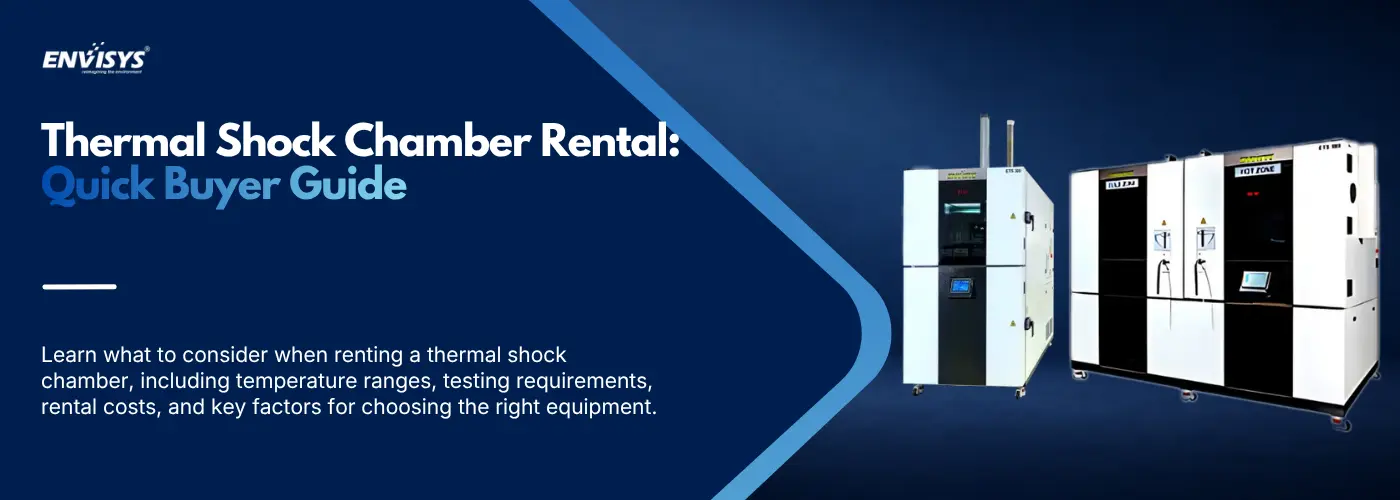
Envisys thermal shock chambers cover a temperature range of -45°C to +210°C. The changeover from zone to zone generally takes less than 10 seconds. On our thermal shock chamber page you can see the construction of these systems.
Industries That Need Thermal Shock Testing
Any product which can be exposed to rapid changes in temperature during shipment, storage, or use is a possible candidate. This testing is more important in some industries than in others.
In semiconductors and electronics, boards, chips and connectors produce heat while operating and cool down during storage or outdoor installations. Solder joints and component packages are common failure points and thermal shock testing will catch them before shipment.
Some of the most rapid temperature changes any product experiences occur in automotive components. A headlamp, sensor or control unit can go from the heat of the engine to cold rain within seconds, so many OEM test specs have thermal shock requirements for suppliers.
Within minutes , an aircraft climbs from a hot runway to cruise altitude and the temperature drops significantly in the aerospace and defence industries . Military equipment is also moved from one vastly different climate to another . That is why standards such as MIL-STD-810 and RTCA DO-160 include temperature shock procedures.
Battery cells and packs combine metals, plastics, electrolytes and adhesives within a limited space. Casings, seals, and internal connections are stressed by sudden temperature changes, which is a safety concern as well as a performance issue for batteries.
The housings, seals and electronics of medical devices must be able to withstand the process of sterilisation, global transportation and use in a variety of clinics.
When Should You Consider Renting a Thermal Shock Chamber
If you have a testing requirement with a specific end date, rental is the best option. These are the cases where it generally makes the most sense:
- You have a short-term project that must be completed in a few months, such as qualifying a new product, responding to a customer audit, or completing a one-time validation program.
- You’re testing a prototype that changes a lot, so you do several rounds, fix what’s bad and go to the next stage.
- You have a limited budget and it is hard to justify a full purchase for a small number of tests per year.
- Demand is ephemeral. Your in-house chamber is booked solid, or a customer wants to do more testing on short notice.
- You want to test the product before purchasing it. Actual size, temperature range and configuration are determined by testing a rented unit.
Key Benefits of Thermal Shock Chamber Rental
When you rent, you remove the burden of routine tasks from your team, and you spread the cost of a single large payment out over the life of the equipment, making it more manageable.
1. Avoiding large capital investments
A chamber purchase requires a considerable initial investment, floor space, site preparation, and a three-phase power connection. For a company that does only a few thermal shock tests a year, the money mostly sits idle. When you lease thermal shock chamber equipment, you pay for the length of your use and keep your capital for product development, hiring or production.
2. Better access to testing equipment
To perform the initial test, a new chamber must be specified, constructed, shipped, installed, and commissioned. You have an existing rental unit, so you can skip the construction phase. Beginning weeks earlier can be the difference between hitting a predetermined launch date or not.
3. No maintenance or calibration is required.
Chambers need regular refrigeration inspections, sensor calibrations and seal inspections. This is a typical clause in many rental contracts, which ensures that the chamber is calibrated and ready for use. Check the scope of your agreement and if needed, ask for a current calibration certificate traceable to a recognised body like NABL or NIST if your quality system requires it.
4. Great for Prototype Testing, and R&D
The test plans for research and development may be changed as the design evolves. You can rent to make sure the equipment is right for the current phase of the project, without having to buy a chamber that is only suitable for one phase.
5. Expand Testing Capacity as Needed
If you have a chamber, renting one can help clear a backlog or allow running two test programs at the same time. At the end of the high season the rental charge is repaid, which is often cheaper than the cost of an additional chamber that stays empty for a long time.
How to Choose the Right Thermal Shock Chamber Rental?
The rental only makes sense if the chamber can run your test. Before signing a rental agreement for a thermal shock test chamber, please check the following points with your test specification.
First of all, the temperature range. Your standard will include the extremes to be achieved in the hot and cold zones, with a little bit of room for error.
Check the chamber size and the load capacity. Your samples , fixtures and cables must be in the basket . More load takes longer to reach the desired temperature . Envisys thermal shock chambers are fitted with baskets capable of holding up to 250 kg.
The transfer time and recovery time determine the severity of your test. Transfer time is the length of time it takes for the basket to travel between zones. Recovery time is the time it takes for a zone to return to its predetermined temperature once the sample arrives. Compare the two . Your standard sets limits for both . See the data sheet .
The chamber design is also worth a look. The majority of electronic and automotive components are best served by a air-to-air thermal shock chamber. This chamber type cycles the sample through hot and cold air rather than immersing it in liquid. Some designs allow the basket to be raised and lowered, while others stack the hot and cold zones. Some people like to place them next to each other and use horizontal basket movement. Ask about the layout of the rental unit and whether it will fit your samples and floor space.
Confirm that the chamber is able to run the profile defined by your standard, whether it is MIL-STD-810, RTCA DO-160, IEC 60068, or a customer-specific specification. Then check the data monitoring. The controller should log the temperature for each cycle, export data for reports, and alarm if there is a problem overnight.
Finally, ask about the power supply the chamber will need, who will install it, and who to call if the chamber fails during the test.
Thermal Shock Chamber Rental vs Buying
So here’s a comparison of the two.
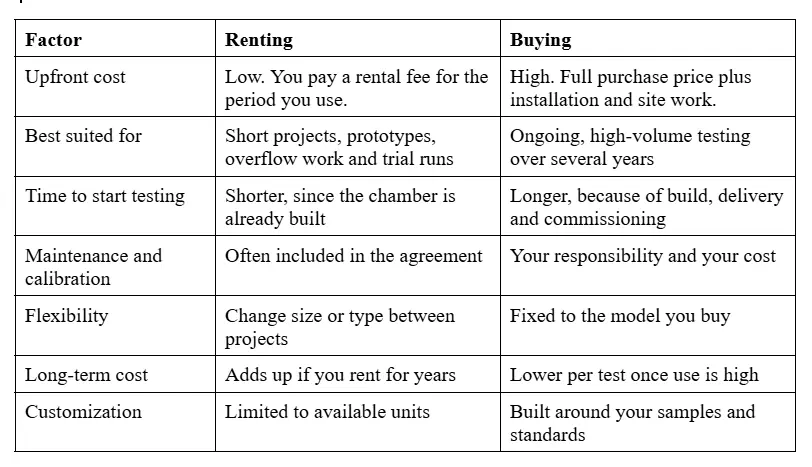
As a rule of thumb, if you expect a chamber to be in use most weeks of the year for several years, buying will probably work out cheaper in the long run. If your testing comes in bursts, renting usually wins. If you are leaning toward a purchase, our guide to thermal shock chamber manufacturers and suppliers covers what to compare between vendors.
Advantages of Working with an Experienced Environmental Test Chamber Supplier
The reliability of a thermal shock test is dependent on the chamber delivering it. If a zone gets out of its set point or the transfer is sluggish, a weak product may pass or a good one may fail. In both cases you lose time and money.
That is why the provider is equally important as the price. A company that specialises in designing and building environmental test chambers has an in-depth understanding of the behaviour of each system under load. They can help you choose the right temperature range and basket size, develop a test profile to meet your standards, and quickly troubleshoot any problems that may occur, such as an alarm that sounds halfway through a program.
Envisys Technologies, based in Bengaluru, is a manufacturer of thermal test systems and environmental test chambers. Our product portfolio includes thermal shock chambers that are designed to accommodate MIL-STD-810, RTCA DO-160, and IEC 60068 testing. If you are thinking of running a thermal shock test program, our engineers can help you determine the chamber specifications you need before you decide to rent or buy.
Conclusion
Thermal shock testing finds weak joints, seals and materials when they are still cheap to repair. For many organisations, thermal shock chamber rental is the most practical way to conduct this testing. It is capital-free and suitable for projects that do not require a chamber throughout the year. Check the temperature range, load capacity, transfer time, standards and data logging before you decide. Choose a provider who knows the equipment.
FAQs
1. What is the rental cost of a thermal shock chamber?
It is not one price. The price depends on the size of the chamber, the temperature range, how long you are renting it for, whether you need it delivered and installed and whether you need support and calibration on site. The most efficient way to get an accurate number is to give your test standard, sample size and timeline to the provider and ask for a quote.
2. When is the best time for a company to rent a thermal shock chamber?
Renting is an excellent option if you have a short term qualification project, want to test a prototype, experience a temporary increase in test demand, have a tight budget, or want to test a system prior to purchase. If the chamber is to be used for most of the year for an extended period, buying it is usually the better choice.
3. What industries use thermal shock chamber rental services?
In electronics and semiconductors, automotive, aerospace and defence, batteries and energy storage, medical devices, telecommunications and renewable energy, thermal shock testing equipment rental is commonplace.And semiconductors, automotive, aerospace and defense, batteries and energy storage, medical devices, telecommunications and renewable energy.