If your car is left outside during a Himalayan winter, the temperature under the bonnet can quickly change from -20C in the morning to parts of the electronics and components heating up to over 100C. Satellites will experience extreme changes in temperature as components will experience direct sunlight and shadows from the earth every orbit. These products must be able to withstand abrupt changes in temperature. If they fail in the field, they will cost much more than if they fail in the lab.
To avoid this manufacturers will test the thermal reliability of their design. But what actually is a thermal shock chamber and why do electronics, automotive and aerospace engineers use them? This guide will explain how they work, different types, what they can be used to test and how to choose one.
Why Sudden Temperature Changes Can Cause Damage
Most materials expand when heated and contract when cooled. If a product is made up of multiple materials with different expansion rates, this can cause issues. A circuit board is made up of copper, fibreglass laminate, silicon chips, plastic packaging and solder. Each will expand at a different rate per degree.
If the temperature is changed slowly the whole assembly will heat up evenly. However, if the temperature changes suddenly the surface will heat up or cool down very quickly. The centre of the product will lag behind and create stress on all of the joints, bonds and seals.
If the product is only subjected to one cycle there may not be any visible damage. However, if it goes through hundreds of cycles micro cracks will appear and will get worse with every cycle. This will cause solder joints to crack, seals to leak and housings to split. The product will work perfectly on day one but fail months later in the hands of the customer.
What Does a Thermal Shock Chamber Do?
Thermal shock chambers subject products to extreme hot and cold temperatures in a very short amount of time. The sample will be moved from one extreme to the other in seconds.
After hundreds of cycles the product will have been subjected to years of real world temperature changes in a short period of time. Engineers will inspect and test the samples to see which joints have cracked, which seals have leaked and which materials have warped. This can be fixed before mass production.
How do Thermal Shock Chambers Work?
Most thermal shock chambers will have two temperature zones. One will be hot with electric heating and fans. The other will be cold with a refrigeration system which will often be a two stage cascade system. Both will be set to their desired temperature.
A typical cycle runs like this:
- The sample will be placed in a basket and will be left in the hot zone until the centre reaches the desired temperature.
- The basket will then be moved to the cold zone (usually less than 10 seconds).
- The sample will soak in the cold zone.
- The basket will then be moved back to the hot zone. This will repeat.
Every time the basket is moved the temperature in the zone will be temporarily affected. The time it takes for the chamber to recover is known as recovery time. Envisys ETS chambers can recover in less than 5 minutes at 150C and -40C with an empty basket.
Types of Thermal Shock Chambers
There are a few different types of thermal shock chambers. Which one you choose will depend on the size and weight of your samples, the standard you are testing to and the space you have available.
1.Vertical Thermal Shock Chambers
These chambers will have the hot zone on top of the cold zone. Samples will be moved using an elevator style basket. This will save space on your floor and reduce the distance the samples need to travel. Vertical chambers are commonly used in electronics labs to test PCBs, connectors and sensors.
2.Horizontal Thermal Shock Chambers
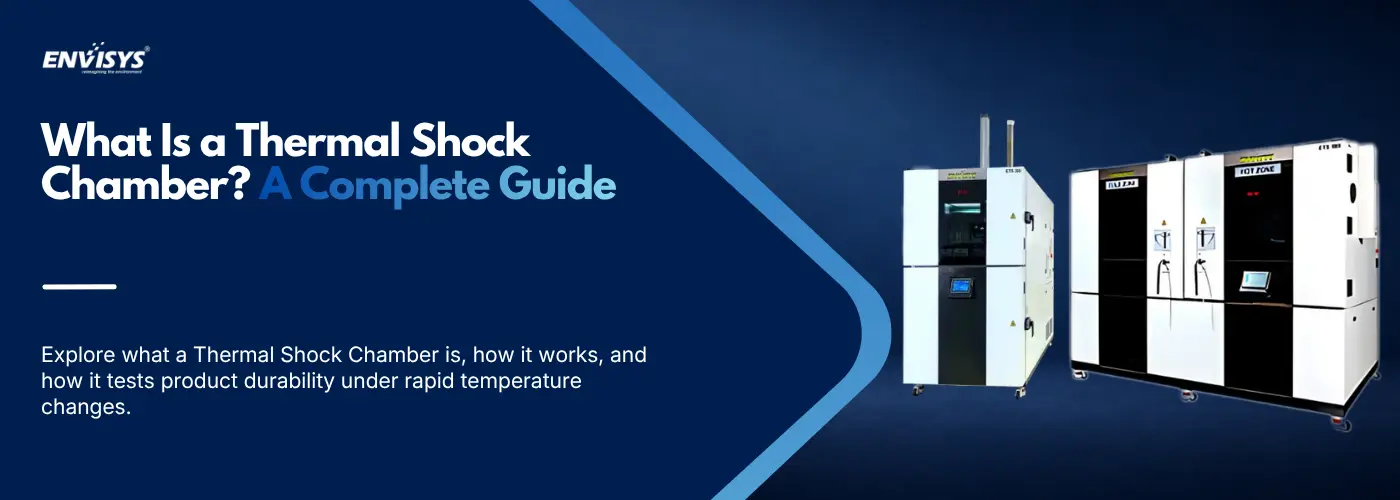
These chambers will have the hot and cold zones next to each other. Samples will be moved using a sliding basket. As the samples are not being lifted against gravity every time, this is ideal for larger and heavier samples such as automotive components. Envisys offer a thermal shock chamber with horizontal basket movement.
3.Two Zone or Three Zone
Two zone chambers will have a hot and a cold zone. Samples will be physically moved between the hot and cold zones. This will provide the fastest and harshest temperature change. Most shock standards will require this.
Three zone chambers will have an ambient test zone. Many designs will have the samples stationary with dampers switching hot or cold air into the chamber. This can be useful if parts need to remain powered or wired up to monitors. Cables won’t be moved with a basket. It will also allow you to pause the samples at room temperature between extremes if required. This will however be slightly slower.
What Products Are Tested in a Thermal Shock Chamber?
Thermal shock chambers can be used in almost every industry.
1.Electronics and PCBs
Most electronic failures will occur at solder joints under BGA and QFN packages. This is because the solder is between a chip and board which have different expansion rates. Testing will show cracked solder joints, raised pads, broken vias and delamination of multi layer boards.
2.Automotive Components
A car component may be exposed to -30C in the morning and over 120C near the engine an hour later. ECUs, sensors, headlamps, connectors and wiring harnesses will be tested to ensure they can withstand this regularly throughout the lifespan of the vehicle.
3.Aerospace Components
Aircraft will quickly go from a hot runway to a cruising altitude where the outside temperature is often around -50C. Avionics, composites and fasteners will be tested to ensure they can withstand repeated climbs and descents without causing cracks to bonds or joints.
4.Batteries and EV Components
Battery cells, battery management systems, power electronics and charging connectors will be tested to ensure seals and internal welds are intact. In a lithium ion pack, cracked seals can pose a safety risk.
5.Medical Devices
Medical devices will often be flown in a cold cargo hold, stored in warehouses and sterilised at high temperatures. Testing will ensure there is no impact on accuracy or patient safety.
6.Military and Defence
Defence equipment may be exposed to sudden changes in temperature. Moving from a hot vehicle to freezing mountain air or high altitudes to desert temperatures. Radios, guidance electronics and tough enclosures will be tested to MIL-STD-810 to ensure they work when conditions change suddenly.
Thermal Shock Testing vs Temperature Cycling
People often mix these two up. The difference is how fast the temperature changes.
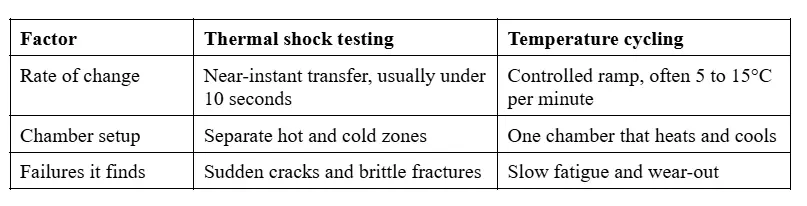
Many test plans use both: temperature cycling to check long-term durability, and thermal shock to check survival against rapid swings.
Key Features to Look for in a Thermal Shock Chamber
When comparing thermal shock equipment you should look for:
A wide temperature range to cover your standard. Envisys ETS chambers can go from -45C to +210C.
- Fast transfer times. The faster the transfer the harsher the shock.
- Fast recovery times. This will ensure every cycle is the same.
- Accurate stability. ±1C will ensure repeatable results.
- Large basket size and load capacity. Envisys models can take up to 250kg.
- Touchscreen with programmable profiles and data logging for long tests.
- Safety features. Over temperature cut out, locked door and emergency stop.
- Built to last. Stainless steel interior, stainless steel basket and double silicone door seals.
Common Standards Used in Thermal Shock Testing
Thermal shock testing standards will dictate the temperatures, transfer times, soak times and number of cycles. Using a recognised standard will mean your results will be accepted by customers and certification bodies. You will most likely encounter:
- IEC 60068-2-14 – International standard for change of temperature testing for electrical and electronic products.
- MIL-STD-810 Method 503 – US military standard for temperature shock.
- JEDEC JESD22-A104 (Temperature Cycling) and JESD22-A106 (Liquid to Liquid Thermal Shock) – Semiconductor components.
- RTCA DO-160 Section 5 – Airborne equipment.
- AEC-Q100 and AEC-Q200 – Automotive electronic components.
Envisys ETS chambers can be used for testing to MIL-STD-810, RTCA DO-160, IEC 60068 and bespoke customer profiles.
Common Problems Found During Thermal Shock Testing
Issues will often be seen across industries:
- Ceramic, glass, plastic housings and potting cracking – Often occurs at sharp corners or thin walls.
- Fatigue of solder joints – This will cause intermittent issues which can be difficult to trace in the field.
- Leaking seals and gaskets – Allows moisture or dust to enter.
- Delamination of PCB layers, coatings and adhesive.
- Plastic warping – This can cause issues with fitting.
- Electrical drift – Sensor values may drift or resistance increases.
Finding these issues in the lab is a good thing. They all have a specific fix such as changing the solder alloy, potting compound or re-designing the seal groove.
How to Choose the Right Thermal Shock Chamber
Firstly consider your product. Measure your largest sample with fixtures and weigh your full load. This will determine what basket size you need and whether you need a vertical or horizontal chamber.
Next consider what standards your customers require. This will determine what temperature range, transfer and recovery times you need.
Consider how you will be testing. If your samples need to remain powered and monitored consider a three zone chamber or cable ports. If you will be testing for long periods of time data logging and alarms are more important.
Think ahead for the next few years. Choosing a chamber with a slightly larger range and bigger basket will allow you to test new products without having to purchase a new one. Ask about calibration, servicing and spares. You don’t want your whole test schedule to be on hold whilst your chamber is sitting idle.
Conclusion
A thermal shock chamber will show how your product will react to sudden temperature changes. By transferring samples between extremes in seconds and repeating hundreds of times, it will show solder joints cracking, seals leaking and weak bonds. This can be fixed at a low cost.
Envisys Technologies design and manufacture thermal shock chambers in Bengaluru. Our chambers can go from -45C to +210C, transfer times are typically less than 10 seconds and support major testing standards. Talk to our engineers and tell them what samples and tests you have. We can help you choose the right configuration.
FAQs
What is the difference between thermal shock and temperature cycling?
Thermal shock will rapidly move the product between hot and cold zones. Temperature cycling will slowly change the temperature in one chamber.
What temperature range do thermal shock chambers operate at?
Most will operate within some of the -65C to +200C range. Electronics testing profiles often go from -40C to +125C or -55C to +150C. Envisys ETS chambers can go from -45C to +210C.
How long does thermal shock testing take?
This will depend on the soak time and number of cycles. Soak times are usually between 10-30 minutes. If you have 15 minute soaks and 500 cycles it will take around 250 hours, just over 10 days.
What standards are used for thermal shock testing?
The most common standards are IEC 60068-2-14, MIL-STD-810 Method 503, JEDEC JESD22-A104, JESD22-A106 & RTCA DO-160. Automotive suppliers will also follow AEC-Q100 & AEC-Q200.

