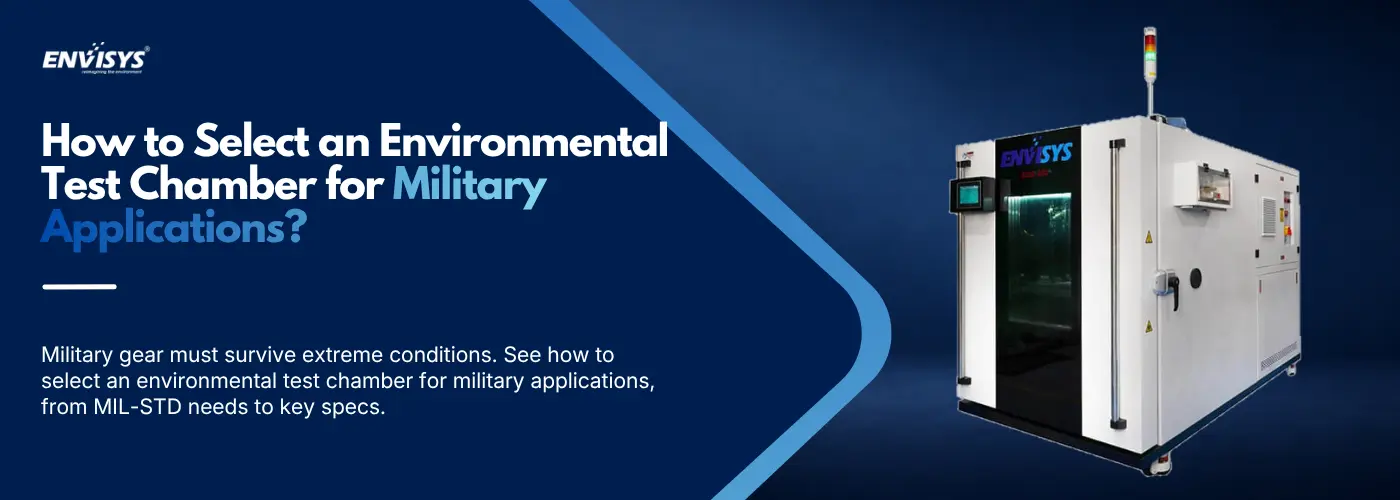
A radio that works perfectly on a test bench isn’t helpful if it fails in a desert at midday or mountain pass at night. Military equipment must be able to withstand the conditions on earth and can be put at risk of putting lives and missions in jeopardy if they fail.
Environmental testing is critical in defense manufacturing and the test chamber you choose will be very important. This guide will outline how to choose the right test chamber. It will cover the standards, technical considerations and the main types of test chambers. If you are new to the equipment, our what an environmental test chamber is and how it works will help give you a good understanding.
Why Environmental Testing is Critical in Military Applications
Defence equipment will be subjected to harsh conditions that are rarely seen in commercial applications. The unit may be exposed to high temperatures (+70⁰C) inside a vehicle during the summer, and then need to start at -40⁰C in a mountain outpost during the winter. It may also be exposed to high altitude conditions in the hold of an aircraft, with high humidity from the monsoon and sand. It will also be shaken for hours during rough terrain.
Each of these conditions causes issues to equipment. High temperatures cause aging, seals to soften and low temperatures cause rubber to become brittle, lubricants to thicken and batteries drain. Humidity causes corrosion to contacts and low pressure can cause bulging of sealed housings. Sudden temperature changes cause solder joints and bonded components to crack.
Environmental testing of defence components replicates these stresses in a controlled environment. This allows engineers to locate any issues before deployment. It also provides documented evidence that equipment meets the conditions outlined in the contract. Without this equipment cannot be qualified.
Military Environmental Testing Standards
MIL-STD-810 is a widely used standard from the US Department of Defence. This has been adopted by many armed forces and defence suppliers across the world. It outlines various test methods but should be adapted to the conditions the equipment will be subjected to. Many common climate tests include Method 500 (Pressure/Altitude), Method 501 (High Temperature), Method 502 (Low Temperature), Method 503 (Temperature Shock) and Method 507 (Humidity). Other tests include rain, salt fog, sand and dust, vibration and combined environments.
There are several other standards including MIL-STD-202 and MIL-STD-883 for component and microcircuit testing. RTCA DO-160 for equipment. In India JSS 55555 is the environmental test standard for defence equipment and in the UK DEF STAN 00-35. Many programmes will also have contractual specifications based on these documents.
The test standard will influence all the decisions made when selecting a test chamber. Including the temperature range, temperature change and data recording.
Factors to Consider When Selecting an Environmental Test Chamber for Military Applications
When selecting a test chamber for military applications, you should start with your test plan. The following factors should be considered by engineers and test labs.
1.Temperature Range
Defence testing can often require more extreme temperatures. MIL-STD-810 defines cold climate categories down to around -51⁰C. High temperature storage can go up to +71⁰C. Component testing may require even higher and lower temperatures. Ensure the chamber can cope with the extremes by selecting one with a large range. Envisys ET Series can go from -70⁰C to +180⁰C to cope with military climate profiles.
2. Size & Load Capacity
Military testing can range from testing circuit cards, to full radios, vehicle electronics, shelters and weapon sub-systems. The chamber must be the correct size to fit the test item, fixturing and cabling. It must also have enough space for air to circulate. The weight is also important. The floor of the chamber must be strong enough to hold the weight. Heavy items will take longer to change temperature. The ET Series has a strong floor to hold up to 500kg of distributed load. Walk-in chambers can hold full systems.
3. Temperature Change Rate
Many military profiles require specific rates of change or transfer. If you choose a slow rate of change chamber you won’t be able to perform the profile. If you push the chamber beyond its design you will struggle with heavy items. Ensure to check the rate of change with your load. For more information on controlled rates of change, see our temperature cycling chamber guide.
4.Humidity Control
Humidity testing under MIL-STD-810 Method 507 will include high humidity cycles to identify any corrosion, ingress and electrical leakage. The chamber must be able to hold a steady humidity for extended periods. The ET Series can control humidity from 10%RH to 98%RH with a temperature range of 10⁰C to 85⁰C. The set point will have a tolerance of ±3%RH.
5.Military Testing Standards
Ask the manufacturer what specific methods the chamber can perform. Ask for examples of test profiles. If the chamber is designed to perform MIL-STD-810, RTCA DO-160 and IEC 60068 profiles it will save time when moving between programmes. Ensure the chamber can be calibrated. Sensors should be able to be calibrated against traceable national standards such as NABL.
6.Reliability & Long Testing
Military testing can often last for days or weeks. If the compressor or heater breaks you will have to start from scratch. Choose a chamber designed to be reliable. It should have solid refrigeration and insulation. Components should be easy to service. Ask how often the chamber will need servicing and if spares are available. If the manufacturer has service engineers they will be able to get the chamber running again in a matter of hours rather than weeks. This is important if your delivery is dependent on test results.
7.Data Monitoring & Control
Defence customers will want traceable testing. The controller should be able to perform the profiles, monitor temperature and humidity throughout the test and export data. Alarms and safety features should be included to protect the test item and chamber. These could include over temperature protection, locked doors and emergency stop. Envisys ET Series chambers have a 10.1” touch screen for real time monitoring and data logging.
Types of Environmental Test Chambers Used in Military Testing
Most defence test labs will use test chambers. The following four are commonly used and will be covered in this environmental test chamber guide for defence testing.
1.Temperature Test Chambers
Temperature test chambers can perform high and low temperature testing. This would include storage and operation at extreme temperatures from Method 501 and 502. These are the most common test chambers in defence labs. They can be benchtop to walk-in sizes. Large walk-in chambers can be used by teams to test systems such as vehicle electronics racks or communications shelters just as they would be in operation.
2. Temperature & Humidity Chambers
This adds humidity control. This can be used for high temperature testing and cyclic humidity testing such as Method 507. These can also be used for temperature testing so are the most versatile option if you can only have one chamber. Ensure humidity can be controlled for long testing and the design will not cause dripping.
3. Thermal Shock Chambers
Thermal shock chambers will move the test item between hot and cold areas in seconds. This can be used for temperature shock testing (Method 503). MIL-STD-810 requires the test item to be moved between conditions in one minute. Envisys thermal shock chambers can normally move the test item in less than 10 seconds. The temperature range is -45⁰C to +210⁰C and baskets can be rated for up to 250kg.
4.Altitude Test Chambers
Altitude chambers reduce the air pressure to simulate flight or high mountain conditions. Often temperature control is included. This can be used for Method 500 testing. Envisys altitude chambers can go as low as 100mbar (Approx 50,000ft) with a tolerance of ±3mbar. Temperature control can be from -40⁰C to +180⁰C.
Mistakes to Avoid When Selecting a Military Test Chamber
The following mistakes are commonly made in defence test labs.
- Not considering the test standard. Often test chambers are purchased using general specifications. This can cause issues as the chamber may not be able to perform the required tests.
- Under estimating the capacity. The chamber may be the right size for circuit cards but may not be big enough for full systems next year. Heavy items can cause slower temperature changes. Ensure you have the largest possible test item.
- Not considering reliability. If the test chamber breaks during testing it will cost much more in lost time.
- Not considering traceability. If the chamber cannot be calibrated and has full data logging the results may not be accepted.
- Purchasing based on price. Service, spares and engineering are just as important as the price.
How Choosing the Right Environmental Test Chamber Improves Reliability in Defence Products
By choosing the right test chamber you can identify any design issues early on. This will save time and money as changes can be made quickly. Engineers can identify if a seal fails in the cold, circuit boards crack under shock and connectors corrode in humid heat. They can then make changes and retest. Identifying failures in the lab will cost less than identifying them in field trials or even in operation.
It will also make the equipment compliant. Accurate and repeatable conditions with full data logging will ensure your test results can be reviewed by defence customers. Over time you will build up a history of reliable equipment. This is the whole point of testing. For more information on how these systems play a role, see our article on the importance and functions of environmental test chambers.
Conclusion
Knowing how to choose the right test chamber for military applications is important. Ensure the test chamber meets your standards, test items and time frame. Consider the temperature range, size, load capacity, temperature change rate, humidity control, standards support, reliability for long testing and data logging. Choose the right test chambers for your testing methods. Work with a manufacturer who can support you. Envisys engineers can help design a set up to keep your equipment mission ready.
FAQs
- What is environmental testing for military equipment?
Environmental testing is when defence equipment is placed in a test chamber and subjected to controlled conditions. This includes high and low temperatures, humidity, altitude and shock. This is to ensure the equipment will work reliably in the environments it will be subjected to.
- What temperature range is required for military environmental testing?
The temperature range will depend on the equipment and testing plan. MIL-STD-810 climate testing usually goes from around -51⁰C to +71⁰C. Component testing may require temperature ranges. Chambers that go from around -70⁰C to +180⁰C will meet military requirements.
- What standards are used for military environmental testing?
MIL-STD-810 is widely used. Other standards include MIL-STD-202, MIL-STD-883, RTCA DO-160, JSS 55555 (India) and DEF STAN 00-35 (UK). There may also be programme requirements.
- How do thermal shock chambers help with military testing?
Thermal shock chambers can quickly move equipment between cold areas. This simulates sudden temperature changes such as when an aircraft takes off from a runway. This puts stress on equipment to identify any solder joints, poor bonds and failed seals.
- How long are military environmental tests?
The length of testing will vary. Thermal shock testing may take 1-2 days. Cyclic temperature and humidity testing often takes 7-10+ full 24hr cycles. Full qualification can take weeks.

