Electronic components rarely fail on the day they are made. Instead, they fail several months later after being cooked in the summer heat of a car and then experiencing a cold night. Most failure will occur due to differing expansion and contraction rates of the materials.
One of the most common methods to identify any weak points in the product is to perform an air to air thermal shock test. This involves a product being rapidly cycled between very hot and very cold air. This article will explore how this test works, what criteria and standards are commonly used and compare it to other methods.
What is Air-to-Air Thermal Shock Testing?
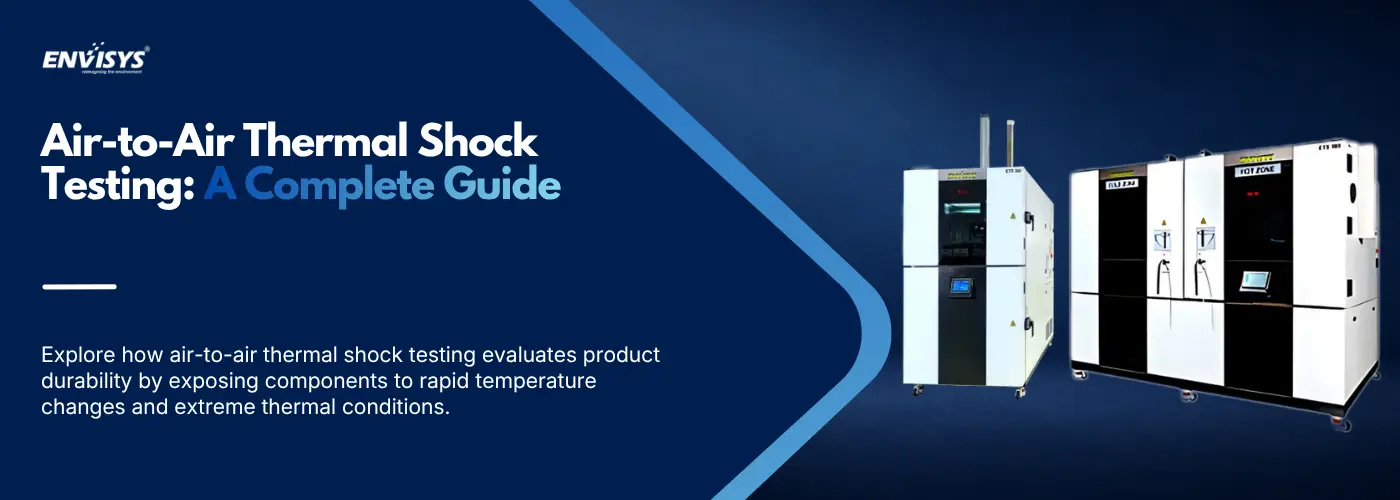
Air-to-air thermal shock testing is a reliability test involving a product being rapidly cycled between two extreme temperatures. The equipment consists of an air to air thermal shock chamber with a hot and cold section. The product is then moved between the two sections or the air surrounding it is changed to cause them to rapidly experience the temperature change.
The key difference with this test is “air”. With liquid to liquid thermal shock testing the product is placed into hot and cold liquid baths. With air-to-air thermal shock the product will be dry, making it ideal for assemblies, connections, sensors and sealed modules.
As an example, Envisys thermal shock chambers can provide testing between -45°C to +210°C. These chambers have separate hot and cold chambers with a basket transfer taking generally less than 10 seconds.
Why Air-to-Air Thermal Shock Testing is Important
Most items are made up of a mixture of different materials, for example copper and fibreglass in a circuit board or silicon and plastic in a chip package. All materials will expand and contract to some degree. Once bonded together any temperature change will put stress on the bond. Over time this will result in cracking, raised pads, damaged wire bonds and leaking seals.
This damage could take years to occur during normal use. Thermal shock testing can identify this damage in a matter of days. The rapid change of temperature puts a lot more stress on the joints than a slow temperature change. This means any issues that would go unnoticed in a normal temperature test will be identified quickly. This provides 3 benefits to manufacturers:
1.More reliable – Engineers will see exactly where and how the design fails. They can then change the material or design and retest.
2. Manufacturing issues – Any bad batch will fail after a short number of cycles. High quality parts will pass.
3. Prevent failures in the field. Finding cracks in the lab means a redesign. Finding them in the field will result in warranty claims, recalls and damage to reputation.
How Air-to-Air Thermal Shock Testing Works
Overall this is a cyclical test. The chamber will heat the hot section and cool the cold section to the set temperatures. The product is placed in one section and left for a period of time to reach the temperature. It is then rapidly transferred to the other section and left for a period of time to reach the temperature. 1 cycle = hot soak + cold soak. The air-to-air thermal shock testing process is as follows.
1. Chamber Preheats Hot and Cools Cold Section
Before transferring the first time the chamber will pre-heat and pre-cool the hot and cold sections to the set temperatures. This means the first cycle will be just as bad as the last.
2. Place Test Specimen in Basket or Fixed Section
There are 2 common types of air-to-air thermal shock chambers. Basket type chambers have the product placed within a basket and moved vertically or horizontally between the hot and cold sections. Fixed section chambers have the product fixed within a test section with dampers to change between hot and cold air. Ensure samples are spaced to allow air to circulate around all surfaces.
3. Rapid Transfer to Opposite Temperature Section
The basket is moved or the air changed to rapidly move the product between the hot and cold extremes. The time taken to do this is known as the transfer time. The shorter this time is the more rapid the temperature change and the more stress. Standards will set a maximum transfer time. Many modern chambers will complete this in seconds.
4. Soak Time
Once the product is in the new section it will be left for a set time. This is known as the soak time or dwell time. The whole product, including the core, will need to reach the section temperature. Small chips may only take a few minutes to reach temperature, however heavy metal housings will take much longer. Recovery is an important factor here. The dwell time will generally be from the time the section reaches the correct position. Recovery times for Envisys chambers will be less than 5 minutes between 150°C and -40°C with no load.
5. Repeat for Set Number of Cycles
The hot and cold soaks will be repeated for the number of cycles you want. Once complete the product will be assessed for cracking, electrical performance changes, leaking seals and other signs of damage.
Standard Parameters for Air-to-Air Thermal Shock Testing
Exact parameters will be from your standard or client specification. However most will fall within the following ranges.
Temperatures: For electronics and automotive testing -40°C to +125°C is common. Some components will have colder temperatures in their specifications, going down to -55°C and below. High temperature materials can go above +150°C. Soak times are generally 10-30 minutes at each extreme. Heavier items will take longer. Transfer times for air-to-air chambers are usually given in seconds. The maximum time is determined by the standard you’re following. Cycle numbers can vary. A quick screening test can be between 50-100 cycles. A thorough certification can be 500 or 1000 cycles or more.
The size of the load will affect results. You must ensure you’re testing within the chamber’s rated load capacity. If you have a heavy basket of samples it will take longer to reach temperature and impact recovery. Envisys thermal shock chambers have baskets with a weight capacity of up to 250kg. This will have a temperature variation of just ±1°C.
Industries Using Air-to-Air Thermal Shock Testing
- In electronics and semiconductors, circuit boards, chips and connections contain many small bonded joints. These will crack under repeated thermal stress. Air-to-air testing is standard for validating new components and screening production quantities.
- Automotive electronics are situated close to hot engines and batteries. They then experience snow, rain and car washes. Control units, sensors, lights and connections will all be regularly thermal shocked to OEM specification.
- Aerospace and Defence equipment can experience a rapid change from a hot runway to cold high altitude temperatures. The military have equipment on their ships and this is deployed in extremely varied climates. Both sectors will incorporate thermal shock into their qualification standards.
- Battery management electronics and connections will need to withstand rapid charging temperatures. Cracking joints or leaking seals on a battery system would be a safety concern.
- This test is also used for medical devices, telecoms equipment and solar inverters. These often experience extreme temperature changes during shipping and installation.
Air-to-Air vs Other Thermal Shock Testing Methods
Typically engineers compare three approaches, one of which is air-to-air testing. Liquid-to-liquid thermal shock transports the product from hot to cold liquid baths. Liquids are far better conductors of heat than air therefore it is a more severe shock. The product becomes moist and the approach is suitable for unpowered components rather than complete assemblies. Thermal cycling is done in a single chamber that is ramped up and down at a controlled rate, sometimes a few degrees per minute. It is more mild and more capable of indicating slow fatigue damage than instantaneous breaking.
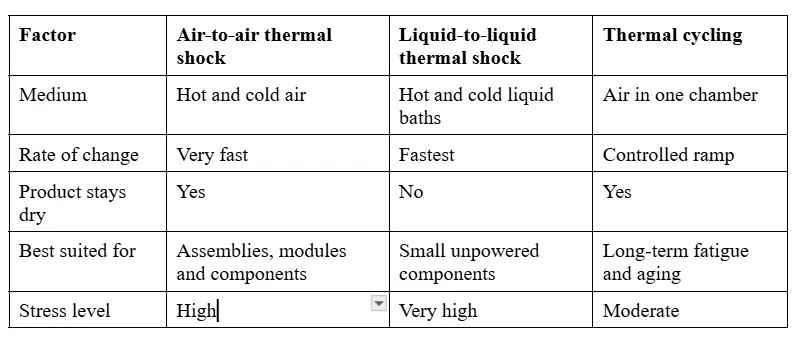
Air-to-air is the most common kind of testing for completed electronics, and it hits the sweet spot: fast enough to be a real jolt, dry enough to be used on final devices.
Standards for Air-to-Air Thermal Shock Testing
Depending on your industry and customer the following are the most commonly used.
- IEC 60068-2-14 – Temperature change testing. Test Na – Rapid temperature change with separate hot and cold chambers.
- MIL-STD-810 – Temperature shock for military equipment (Method 503).
- MIL-STD-883 – Temperature cycling for microelectronics (Method 1010). Typically performed in air-to-air chambers.
- JEDEC JESD22-A104 – Temperature cycling for semiconductor components. Sets test conditions used throughout the chip industry.
- RTCA DO-160 – Temperature variation for airborne equipment (Section 5).
- ISO 16750-4 – Climatic loads for automotive electrical and electronic equipment. Includes temperature shock.
Many OEM’s will also have their own test specifications based on these documents. When reviewing air to air thermal shock test standards ensure the temperatures, soak times, transfer times and number of cycles match your chamber.
When Should Air-to-Air Thermal Shock Testing be Used?
If your device needs to detect unexpected temperature changes during use and needs to remain dry then air-to-air thermal shocking is the perfect solution. This would be for electronics in vehicles, outdoors, anything transported by air or stored in non-heated areas.
This can also be used if you are qualifying a new design, comparing materials or suppliers or screening production batches. If your product is a small non-powered component and the standard requires liquid shock then liquid to liquid is the best solution. If you’re interested in analysing slow degradation over a long service life then thermal cycling may provide more useful data. If you’re looking at chamber options for your lab, our thermal shock chamber manufacturers and suppliers can help you.
Conclusion
Air-to-air thermal shock testing rapidly cycles products between hot and cold air to identify any weak joints, bonds or seals. This is included in key standards such as IEC 60068-2-14 and MIL-STD-810. It can be performed on full assemblies and ensures products remain dry. To achieve good results you must choose the right temperatures, soak times, transfer times and number of cycles. You’ll also need a chamber that can consistently maintain these. Envisys engineers can help you choose the right chamber for your test standard.
FAQs
What is air-to-air thermal shock testing used for?
It is used to identify weak points in products that experience sudden temperature changes. This could be cracked solder joints, failed seals and broken bonds. Manufacturers use it to qualify new designs, screen production batches and prevent failures in the field.
What is the difference between thermal shock and thermal cycling?
Thermal shock will rapidly move the product between 2 extreme temperatures. This causes sudden stress. Thermal cycling will increase and decrease the temperature at a controlled, slower rate. This is better for analysing long term fatigue.
What temperature range is used?
This will depend on your standard and product. However commonly -40°C to +125°C is used for electronics and automotive parts. Some specifications will be colder or hotter. Envisys thermal shock chambers can go from -45°C to +210°C.
Which industries use air-to-air thermal shock testing?
Electronics and Semiconductors, Automotive, Aerospace and Defence, Batteries and EVs, Medical Devices, Telecom and Renewable Energy.
What standards apply?
Common standards include IEC 60068-2-14, MIL-STD-810 (Method 503), MIL-STD-883 (Method 1010), JEDEC JESD22-A104, RTCA DO-160 (Section 5) and ISO 16750-4. Many will also have their own specifications.