Most laboratories will choose a chamber from a catalog for the vast majority of testing they undertake. However once the product or testing requirement is outside of the chamber specification we may require a customized environmental test chamber.
This will depend greatly on the requirements specified to the manufacturer. The following will guide you through the necessary requirements for a customized environmental test chamber.
What is a Customized Environmental Test Chamber?
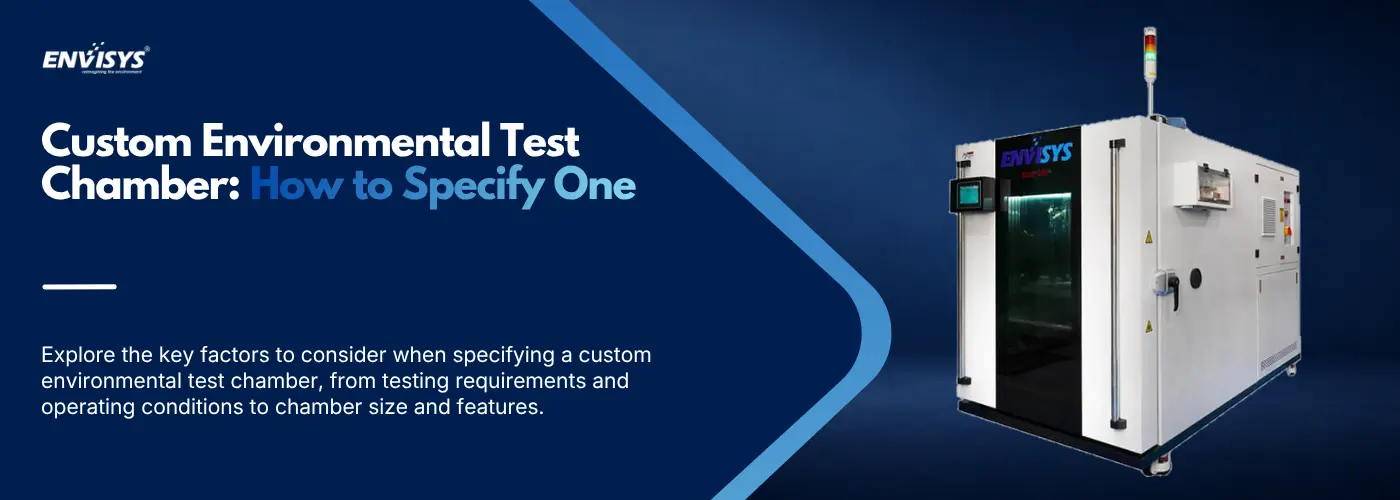
A customized environmental test chamber is a temperature or climate chamber where the requirements are based around the product being tested. They contain the same core components but will have been sized and configured differently.
The manufacturer can configure the chamber to have bespoke internal dimensions and door size, increased cooling to allow quicker ramp rates and increase the temperature or humidity range. They can also be configured with ports, windows, reinforced floors, fixtures, and bespoke controller set-ups to allow your exact profiles. We can configure large bespoke chambers to allow the testing of whole vehicles, battery packs and rack level systems.
When is a Customized Environmental Test Chamber Required?
If your requirements can still be fulfilled with a catalog chamber, with some margin for error, you will likely find a standard chamber to be cheaper, quicker to deliver and have a proven performance. However if one or more of the following apply you may want to consider a bespoke chamber.
- Specimen / Fixture will not fit into the largest available chamber or door opening.
- The specimen is heavier than the standard floor/shelf rating.
- Testing requires a larger temperature range or ramp rate than standard cooling can allow.
- The specimen is active and outputs too much heat causing the chamber to go out of setpoint.
- Extra ports are required for connection to external equipment e.g. shaker, power supply.
- Site restrictions on footprint, height, power and cooling water.
If you need to adjust your testing to fit the chamber then you will need a chamber designed for your testing.
What are the Key Specifications to Consider?
There are six key areas to consider when choosing a customised environmental test chamber. All values should be taken from your test standard.
1. Temperature Range and Ramp Rate
Provide the minimum and maximum temperatures required for your testing. It is recommended to provide a bit of margin. If testing between -40C and +85C you will find it works better if the chamber has a little more range. Our ET-Series can go down to -70C and up to +180C.
Ramp rate is just as important. Provide the ramp rate you need in C per minute, whether it needs to be linear and if it applies to the chamber air or specimen. Also provide the dwell times and total amount of cycles. 1000 cycles will put a lot more stress on the compressors than one cycle of qualification.
2.Humidity and Temperature Pairs
Humidity will always be paired with a temperature. All climates chambers have a Climate Envelope, this is the range of temperature and Relative Humidity pairs it can achieve. Our ET-Series can control humidity from 10% to 98%RH with a temperature range of +10C to +85C.
List all the temperature and humidity pairs within your profile e.g. 85C, 85%RH for damp heat. Ensure they fit within the climate envelope. Provide how much fluctuation you are happy with (Our chambers can provide ±3%RH at setpoint). Also state whether you are okay with condensation on the specimen.
3. Workspace Size, Specimen Weight and Heat Load
Ensure your chamber can fit your specimen and fixture with some clearance. Provide the dimensions, weight and distribution.
Most people forget about this. If your product will be active during testing, provide the amount of heat it is producing. Active products like inverters or battery modules can cause the chamber to go out of setpoint if the cooling has not been sized for it. Measure your room to provide door sizes, ceiling height, floor loading and service access.
4. Accuracy and Uniformity
Accuracy is how accurate the chamber can hold temperature at the control sensor. Uniformity is how much variation there is in the workspace at the same time. The chamber could be exactly 85C at the control sensor, however one corner could be 2 degrees colder.
For most testing, uniformity will determine if your specimen has seen the same conditions. Our walk-in chambers provide uniformity of less than of ≤1.5C up to 1000L, less than 2.0C between 1000L and 2000L and less than 2.5C above. Ask for the uniformity under load and unloaded. Discuss how you would want them to map e.g. IEC 60068-3-5/7.
5.Fixtures, Ports and Equipment
Provide information on how you want your specimen to be held. Provide load rating for shelves/fixtures. Provide how many cables and hoses you need going through the wall, including diameters. Request sealed ports in the correct places, including feedthroughs for specimen sensors.
If you will be connecting to external equipment mention this. If you will be placing the chamber over a shaker for combined testing or connecting to a battery cycler.
6. Safety, Controller and Data Logging
Ensure the controller can perform your full profile, including ramps, dwells, loops and humidity changes without manual intervention. Ask how many programs can be stored onto the controller and if it can be monitored remotely.
Depending on the specimen, safety features will be required. All chambers will have over temperature, door lock and emergency stop. Battery testing may require gas detection, pressure release and fire suppression. Data logging will need to be provided. Provide what needs to be logged, how often and in what format. If you require traceable data for audits, ask for calibration certificates that are traceable to NABL or equivalent.
Which Environmental Test Chamber Configuration Fits Your Application?
The test decides the configuration.
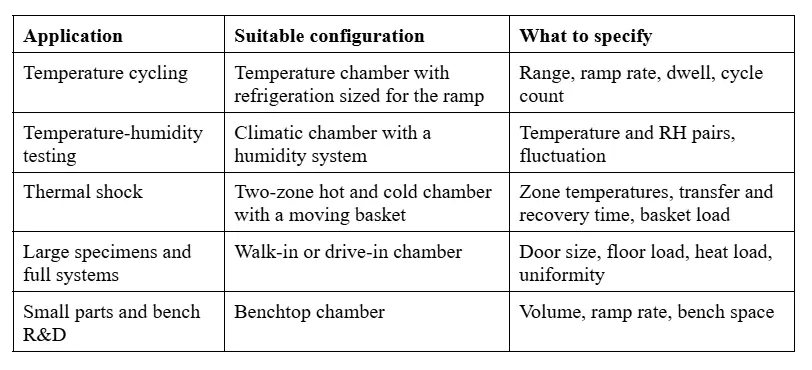
Thermal cycling and thermal shock are often mixed up. Cycling uses controlled ramps and dwells to study fatigue over repeated exposure. Thermal shock moves the specimen between two pre-conditioned zones, normally in under 10 seconds. The Envisys ETS-Series covers -45°C to +210°C with basket loads up to 250 kg. You can compare the full range on the Envisys environmental test chambers page before deciding what to customise.
How to Prepare a Specification Brief Before Requesting a Quote
Creating a specification will help you to get quicker, more accurate quotes. This should be 1-2 pages long.
- Product Information : What is your specimen? What are the dimensions, weight, how many specimens per test and is it active?
- Test Profile : Provide the standard/procedure. Provide the temperature, humidity, ramp rates, dwell times and cycle counts.
- Environmental Extremes : Provide the extreme setpoint and margin.
- Tolerances : Accuracy, uniformity and humidity tolerance (underloaded or loaded).
- Heat Load : Provide the amount of heat dissipated per test point.
- Interfaces : Provide how you want your specimen held. How many cables and ports are required? What diameter? Request sealed ports in correct places. Feedthroughs for specimen sensors.
- Site Details : What power do you have available? (e.g. 415VAC 3 Phase). Cooling water, drainage, floor space, ceiling height and delivery.
- Safety : Alarms, locks and specimen hazards.
- Documentation : Drawings, manuals, calibration certificates and acceptance tests.
What Can Go Wrong with a Poorly Specified Customised Chamber?
Most issues can be traced back to one missing piece of information.
- No information on the size of the specimen including fixtures will lead to a small workspace. This will affect uniformity.
- No ramp rate specified for a loaded chamber will not meet requirements.
- No heat load provided will lead to the chamber going out of setpoint due to an active product. This can be resolved by upgrading the cooling.
- A poor uniformity requirement will mean specimens on different shelves will have different conditions.
- No information on site details will lead to the chamber not being able to be connected.
- No acceptance criteria will mean there is no agreement on how to prove the chamber meets your order.
Any of these issues will incur a large cost to resolve once delivered.
How to Judge a Customised Environmental Test Chamber Manufacturer
Look at how they respond to your specification. A good engineering team will provide questions, heat load calculations and a layout.
Ask about their experience with similar specimens. Have they performed testing to similar standards (MIL-STD-810, IEC 60068, RTCA DO-160 and ISO 16750)? Ask how they will prove the performance. They should be able to provide a factory acceptance test to your criteria with uniformity mapped using calibrated sensors. This should be something they can provide and you can observe.
Ask about their after-sales. Will they visit your site, install, commission and train? How quickly can they dispatch a service engineer? What spares do they keep locally? If your laboratory is in India having a manufacturer with local engineers will reduce the time it takes to commission and repair. Our chambers are designed and manufactured in Bengaluru.
Specify the Test First, Then Choose the Chamber
A bespoke chamber will only be as good as the requirements you define. Define your specimen, profile, heat load, tolerances and site. This will allow suppliers to provide quotes based on the same information.
If you are looking to perform a test that a standard chamber cannot do, speak to our engineering team at Envisys Technologies. Provide your specification and they will calculate how to configure the chamber to suit your product and lab.
FAQs
- What is a Customised Environmental Test Chamber?
A chamber to test products at controlled temperatures and humidities. This is required when your specimen size, testing and equipment does not fit with a standard chamber. Examples include EV battery packs and active electronics.
- What information is required to order a Customised Environmental Test Chamber?
Specimen size, weight and heat load, temperature range, ramp rate, humidity pairs, uniformity and accuracy tolerances, fixtures and ports, safety and data logging requirements, site details and acceptance criteria.
- How much do they cost?
The price will depend on the workspace, temperature range, ramp rate, humidity, heat load and options. A bespoke environmental test chamber will generally be more expensive than a standard chamber of similar size. Providing a full specification will provide the quickest and most accurate quote.
- How do I know they will meet my testing requirements?
Include the acceptance criteria in the purchase order. Have a factory acceptance test completed with uniformity mapped using calibrated sensors. Ideally with your specimen or dummy load. Repeat the main checks after installation.