Some products will fail over time however some will fail instantly when exposed to a sudden change in temperature. For example, a car sensor may be exposed to water after being driven for a long amount of time and a circuit board could crack or short circuit if moved from a warm factory to a freezing cargo hold. A thermal shock chamber is used to help identify where weaknesses are present in the product.
Understanding how a thermal shock chamber works is helpful when selecting test equipment or when creating a reliability programme. This article will outline the process in a thermal shock chamber, the components, two zone vs three zone chambers and factors that affect results.
Why Thermal Shock Testing Is Used
Almost all products will have different materials that have different expansion and contraction rates. For example, the circuit board will have copper and fibreglass, the chip package will have silicon and plastic and the lamp will have glass and aluminium. The bond between these will cause stress.
If there is a slow change in temperature then the material will have time to adjust. However, if there is a rapid change in temperature then the outer layers of the material will cool down quicker than the centre causing much faster stresses. This will cause cracking of the solder joints, leaking of seals, peeling of coatings and separation of bonded materials.
Thermal shock testing is used to replicate these rapid changes in temperature. This allows manufacturers to identify any weaknesses or faults in the design and manufacturing process. Many qualification standards include thermal shock testing such as MIL-STD-810, RTCA DO-160 and IEC 60068. If the product fails during testing in the lab it can be redesigned. If it fails in the field then it will cause issues with warranty claims, recalls and loss of customer confidence.
How A Thermal Shock Chamber Works
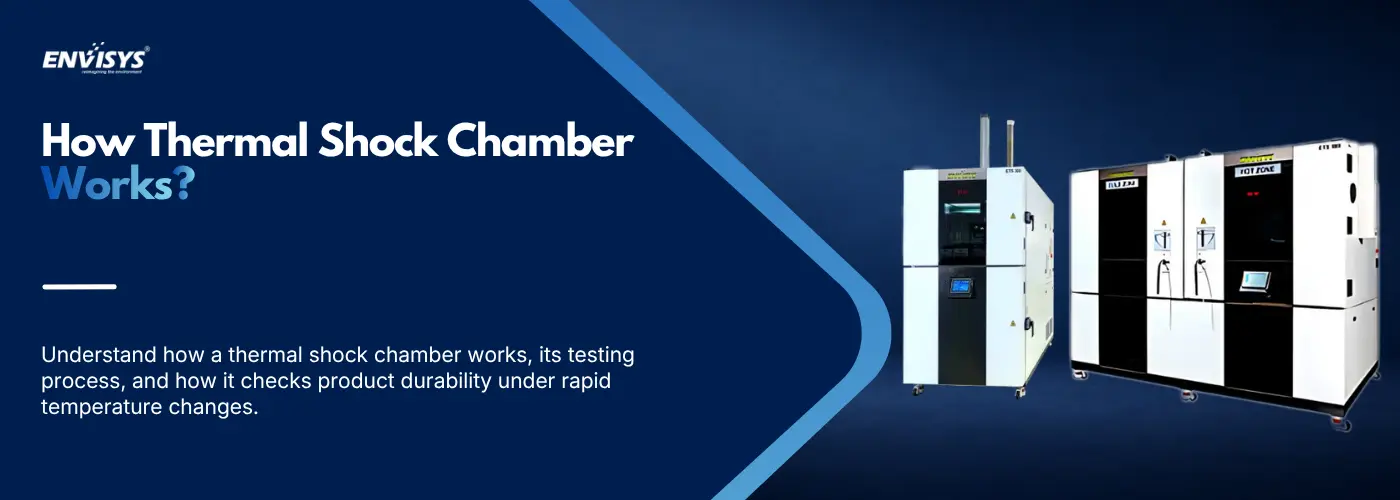
The principle behind a thermal shock chamber is that it has two zones, a hot zone and a cold zone. The test sample is moved from one zone to another in a matter of seconds. It will stay in the zone for a period of time to allow the sample to reach the temperature and then move again. This completes one cycle and will be completed hundreds of times with no human intervention. Below are the steps:
Before testing begins engineers will usually perform checks on the samples. This will provide a baseline such as electrical readings, photos or seal testing. This will allow comparison after testing.
Step 1: Chamber Preparation
The chamber will be heated and cooled to reach the set temperatures. Most chambers will be heated and cooled to above the test temperatures to allow for the sample and basket to be at room temperature. Once the sample and basket enter the chamber it will cause the cold zone to warm up or the hot zone to cool down. For example Envisys thermal shock chambers can heat up to 210°C and cool down to -45°C. This means the first cycle will be as harsh as the final cycle.
Step 2 : Product Placement
The product will be placed into the carrier/test basket. The samples should be spaced out to allow air to circulate around the sample. The samples should not block any airflow ports. If the product requires power or monitoring during testing then the cables will go through an airtight port on the chamber. The weight of the load will impact how quickly the basket will reach the temperature. The basket should not exceed the rated capacity of the chamber (up to 250kg on Envisys models).
Step 3 : Sample Shocks
The sample will be shocked by moving the basket from the zone to the cold zone or vice versa. This is done using a motorised system. This is measured as the transfer time and is one of the most important numbers in the thermal shock testing process. The shorter the transfer time the more of a change and stress caused. On Envisys chambers the transfer time is usually over 10 seconds.
Step 4 : Sample Stress
When the sample reaches the zone the surface of the sample will rapidly change temperature however the centre will be slower to change. This is where the stress occurs. The sample will stay in the zone for a period of time, this is known as the soak time. During this time the zone will need to recover. The recovery time is how long it takes for the zone to reach the set temperature. On Envisys chambers it will take less than 5 minutes to recover between 150°C and -40°C.
Step 5 : Repeat Cycles
Once the soak time has finished the basket will be moved back to the zone and the process repeated. The controller will complete the number of cycles set within the test programme. This could be 50 cycles for a quick screening test or several hundred for a qualification test. After the samples will be checked for any cracking, faults, leaking seals etc.
Main Components Of A Thermal Shock Chamber
There are several systems that need to work together to ensure accurate and repeatable results.
1.Heating System
The zone will be heated using electric heaters. They require power to quickly recover when a cold basket enters the chamber. The hot zone will be insulated from the cold zone and outside.
2.Refrigeration System
The zone will be cooled using a refrigeration system. This will remove heat from any warm baskets entering the zone. To reach sub-zero temperatures a cascade system is often required. This will utilise two refrigerant circuits. This is usually the factor that determines how low the chamber can go and how quickly the cold zone will recover.
3.Basket Transfer / Air Switching System
This is where the sample will be shocked. If using a basket system then the basket will be moved between the zones using a motorised system. Cold air will not mix due to seals around the opening. If using an air switching system then the sample will remain in place and dampers will be used to blow hot or cold air into the test area. The system must be quick to ensure repeatable results.
4.PLC / Controller
The controller will control the test. The operator will set temperatures, soak times and number of cycles using the touch screen. The chamber can then be left to run automatically. The controller will record the temperatures during each cycle for reporting. It will also monitor the safety systems such as over temperature, locked door and emergency stop button.
5.Air Circulation System
Fans will be used to circulate the air within each zone. This ensures the entire basket reaches the temperature. If there was no air circulation then the edges of the basket would heat or cool quicker than the centre causing variation in results. The airflow system has been designed to help with recovery between transfers.
Two-Zone vs Three-Zone Thermal Shock Chamber Working Principle
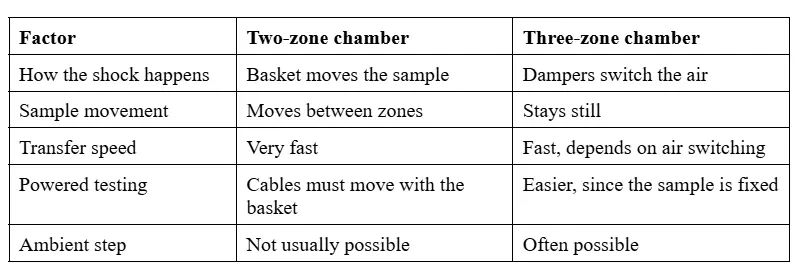
A two-zone chamber has a zone and a cold zone usually stacked one above the other. The basket moves up and down between them. The sample goes straight from hot to cold and back. This design gives short transfer times and handles heavy loads well.
A three-zone chamber adds an area, the test zone, where the sample stays still. The hot and cold zones sit beside it. Dampers switch which air flows into the test zone. Because nothing moves, cables for testing are easier to manage. Some three-zone chambers can also bring the test zone to room temperature between the cold steps, which certain standards call for.
Factors That Can Affect The Thermal Shock Chamber
The largest factor will be the size and weight of the load. The more mass the more heat will be added or removed causing slower recovery of the sample and zone. The transfer time will determine how harsh the test is. If the system is slow then the shock will not be as harsh as intended. The recovery time will determine if the soak times are accurate. This will depend on the heating power, refrigeration capacity and airflow.
Temperature uniformity is important. If one corner of the basket is a few degrees off then the samples in that corner will have a different test. Temperature fluctuation is a measurement that shows how stable each zone is. Envisys chambers have a fluctuation of ±1°C. The seal, room temperature and calibration will all affect accuracy. If the seal is worn then cold air will mix, reducing the shock and wasting energy.
The test programme will need to be suitable for the product. If the soak time is too short then the centre of a heavy part will not reach the target temperature therefore not experiencing the full stress. Understanding how the thermal shock chamber works will help engineers decide on suitable soak times, number of cycles and load sizes.
Common Uses Of Thermal Shock Chambers
The users of thermal shock chambers are electronics and semiconductors. Circuit boards, chips, connectors and solder joints are very sensitive to sudden temperature changes. Automotive suppliers will test control units, sensors, lights and connectors that will experience hot temperatures from the engine and cold temperatures. Aerospace and defence teams will qualify avionics and field equipment that will rapidly move between climates. Batteries, telecoms, medical devices and solar will also be tested for reliability. You can see how we build these systems on our thermal shock chamber page.
Final Thoughts
A thermal shock chamber works by having two different temperatures ready. The product will be moved rapidly between the two temperatures repeatedly to show any weaknesses in bonds, seals or materials. The heating system, cooling system, movement system, controller and airflow system will need to work together to ensure accurate and consistent shocks. Understanding how each component works will help to assess chambers, understand details and select the right system for your testing needs. If you are considering different vendors then our overview of thermal shock chamber manufacturers and suppliers will help you know what to look for.
FAQs
1.What is the difference between thermal shock and thermal cycling?
Thermal shock will move the item between two high and very low temperatures in a short amount of time. This will cause immediate stress. Thermal cycling will gradually change the temperature at a set rate. This is more suitable for looking at long term wear and tear.
2.Can thermal shock chambers test electronics?
Yes, electronic devices are one of the most common items tested. Circuit boards, chips, connectors and components can be tested with or without power going through the cable ports.
3.What products are tested in a thermal shock chamber?
Some common examples are circuit boards, semiconductors, connectors, automotive sensors, control units, lights, avionics, battery components, medical devices and products made with bonded materials such as glass, ceramics, plastics and metals.
4.How many zones do thermal shock chambers have?
Most chambers will have two zones, one hot and one cold. There will be a basket that moves between the two. Some will have three zones with a test area. The item will stay in place and hot and cold air will be switched in.