A commercial cabin holds pressure equivalent to about 8,000 feet. Outside the fuselage at cruise, ambient sits closer to 200 mbar, roughly a fifth of what the aircraft left behind on the runway. Equipment in an unpressurised bay lives in that second number.
Thin air changes what a component does. A power supply that ran at 60°C on the bench climbs well past it once there is not enough air to carry heat away. A sealed enclosure assembled at sea level now has higher pressure inside than out, and pushes on its own gasket. Air becomes a weaker insulator, so a clearance that held off a voltage on the ground can arc.
Aerospace altitude test chambers reproduce those conditions on the ground, where a failure is a measurement rather than an incident. This guide covers what the chambers are, why the testing exists, how a test runs, and what to check when specifying one.
What Is an Aerospace Altitude Test Chamber?
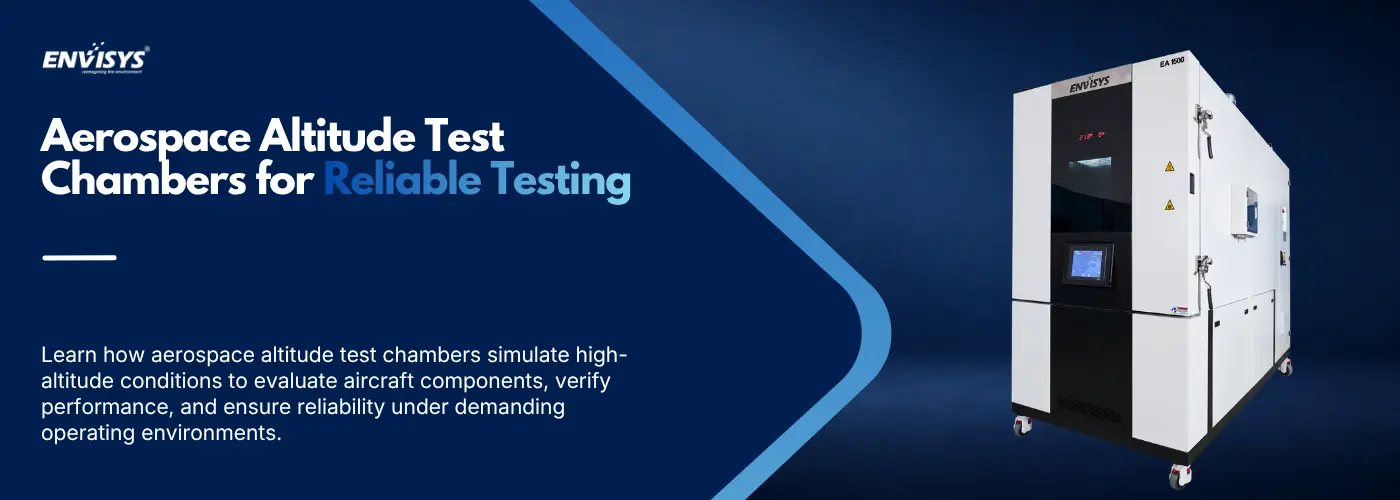
An aerospace altitude test chamber is a sealed, reinforced enclosure that reduces internal pressure to match a target altitude while controlling temperature independently.
A vacuum system draws air out. Envisys altitude chambers reach around 100 mbar with an accuracy of plus or minus 3 mbar, pulling from atmospheric to that setpoint inside 45 minutes across a temperature range of minus 40°C to plus 180°C. Systems built for space hardware go far below, under 0.001 mbar.
Temperature alone misses half the picture. Air pressure governs how heat leaves a component, so a chamber that drops temperature without dropping pressure tells you nothing about thermal behaviour in flight.
Why Aerospace Components Need Altitude Testing
Failure at altitude carries consequences failure on the ground does not. Nobody pulls over to check a malfunctioning part mid–flight, and nothing gets swapped on a satellite once it is in operation.
Three mechanisms make ground–level testing insufficient. Convective cooling weakens as air thins, so a component that stays cool at sea level can overheat at altitude with no change in ambient temperature or load. Fan–cooled equipment suffers worst, because a fan pushing thin air moves very little heat.
Pressure differentials stress seals directly. A gasket that held at atmospheric pressure must now contain whatever is trapped inside against a much lower outside pressure.
Dielectric strength falls with pressure. Around a few torr, air reaches its minimum breakdown voltage, which is why creepage and clearance distances get derated for high–altitude equipment rather than carried over from a ground–level design.
Batteries lose capacity under combined cold and low pressure, and lubricants respond to pressure change. None of it appears reliably in a standard temperature chamber.
How Aerospace Altitude Test Chambers Work
The sequence stays the same whatever the component.
Step 1: Chamber Creates Low–Pressure Environment
A vacuum system draws air from the sealed chamber, bringing internal pressure down to the target altitude. Rate of change is programmed rather than incidental, and is frequently part of what the test measures: a component that survives a slow pressure descent may not survive a fast one.
Step 2: Temperature Conditions Are Controlled
Heating and cooling systems bring the chamber to the specified temperature while pressure is managed, anywhere from deep cold to elevated heat. Most programmes run both together, because testing them sequentially misses the interaction that causes the failure.
Step 3: Test Sample Is Monitored During Exposure
With the component at target pressure and temperature, engineers monitor performance throughout the exposure. Keeping it powered is standard practice, because thermal failures only appear when the component is generating its own heat and cannot shed it.
Step 4: Chamber Returns to Ambient Conditions
Pressure and temperature return to ambient in a controlled manner rather than being released, because an uncontrolled vent damages both specimen and chamber. The component is then inspected and function tested, and the logged data becomes the qualification record.
Key Tests Performed Using Aerospace Altitude Test Chambers
1.High Altitude Simulation Test
Holds a component at a specified altitude equivalent for a set period, confirming it keeps functioning under sustained low pressure. This is the baseline operational test.
2. Rapid Decompression Test
Simulates sudden pressure loss, such as a cabin losing pressurisation. RTCA DO–160 defines the profile as a drop from 8,000 feet to 40,000 feet in no more than 15 seconds, with the equipment expected to survive without rupturing or throwing debris.
3.Altitude + Temperature Combined Testing
Runs both stresses in one profile, which is what components actually meet. A part can pass altitude at room temperature and cold at sea level, then fail when the two arrive together.
4.Thermal Vacuum Testing
Pushes into deep vacuum, below roughly 0.001 mbar, combined with extreme temperature cycling. At that pressure convection stops entirely and heat moves only by conduction and radiation, exactly as in orbit. Outgassing matters here too, because materials release volatile compounds that condense on optical surfaces.
5.Endurance / Soak Testing at Altitude
Holds a component at altitude conditions for an extended period rather than a brief exposure, revealing gradual failures and performance drift that a short test never surfaces.
Industries and Aerospace Components Commonly Tested
Commercial aviation, defence and space programmes all run altitude testing, and the list of test articles is long: avionics and flight control systems, communication and navigation equipment, sensors and pressure transducers, batteries and power supplies, connectors and wiring harnesses, structural seals and enclosures. Anything installed on an aircraft, satellite or high–altitude platform is a candidate, and how rigorously it gets tested scales with how critical it is to the system.
Important Specifications to Consider When Choosing an Aerospace Altitude Test Chamber
1. Altitude/ Pressure Range
Confirm the chamber reaches the altitude your standard names, with margin. Around 100 mbar covers roughly 50,000 feet, which handles most airborne equipment. Space and near–space work needs orders of magnitude lower.
2. Temperature Range
Check the range covers both the cold of high altitude and any elevated condition in your profile, then check it holds those extremes under vacuum with the specimen loaded and powered. That is a harder problem than holding them in air.
3.Pull–Down Rate
How quickly the chamber brings pressure and temperature to target. This decides whether rapid decompression profiles are achievable at all, and sets cycle time on everything else. Ask for the figure with a realistic load, not an empty chamber.
4. Chamber Volume / Test Space
Size for the test article plus fixtures, mounting hardware and instrumentation, with clearance around it. Count the feedthroughs you need for thermocouples and power, because adding ports later is rarely practical.
5. Control Accuracy & Uniformity
Two different figures. Accuracy is how tightly the chamber holds its target, commonly within plus or minus 3 mbar. Uniformity is the spread across the working volume, deciding whether every part of the article sees the same condition. Ask for uniformity under load with mapping data.
6. Data Logging & Automation Features
Aerospace qualification is a documentation exercise as much as a technical one. The chamber should log pressure, temperature and specimen channels with timestamps, export to a format you can still open in five years, and report the achieved profile against the target.
Common Standards for Aerospace Altitude Testing
RTCA DO–160 Section 4 covers temperature and altitude for airborne equipment, including operating and ground survival conditions, decompression and overpressure. For anything going into a commercial aircraft this is normally the controlling document.
MIL–STD–810 Method 500 is the defence standard for low pressure, defining storage, operational and rapid decompression procedures, and it is widely cited outside defence too. For space materials ASTM 5505 governs outgassing with acceptance limit of 1.00% total mass loss and 0.10% collected volatile condensable material.
Above all of these sit customer specifications, often stricter than the published standards. Confirm which document governs your programme before specifying anything.
How to Select the Right Aerospace Altitude Test Chamber for Your Application
Start from your actual test requirement rather than a generic specification sheet.
Identify the altitude and temperature ranges your components must survive, taken from the standard your industry requires and the operating envelope of the platform the component will fly on. Those two sources sometimes disagree, and the stricter one wins.
Size the chamber against real test articles, including fixtures, wiring and any monitoring equipment alongside them. Weigh pull–down rate against your test plan: it matters a great deal for rapid decompression work and far less for steady–state soak testing, so do not pay for speed a programme will never use.
Then confirm the control and data logging can produce the standards–compliant record your qualification process needs. Envisys Technologies‘ altitude test chambers are built around these criteria, and reviewing a shortlist against them beats comparing headline pressure figures.
Why Aerospace Manufacturers Choose Custom Altitude Test Chambers
Standard configurations work for plenty of applications. Aerospace programmes are frequently not among them.
Test articles come in awkward sizes. Profiles combine pressure, temperature and sometimes vibration in ways a catalogue unit was never built to run. Requirements get tied to a particular airframe or spacecraft platform rather than a general specification.
Custom chambers let manufacturers match equipment to the test article and the standard instead of working around an off–the–shelf unit’s limits. That matters most for larger assemblies, unusual mounting requirements, and programmes needing a combination of pressure range, temperature range and pull–down rate no standard model offers. Envisys Technologies‘ aerospace applied solutions are built this way, engineered around a specific programme rather than issued in one fixed configuration.
Conclusion
Ground–level testing cannot tell you how a component behaves once the air thins around it. Altitude chambers combine low pressure with controlled temperature, and in some cases deep vacuum, to give a realistic picture before any of it matters in flight.
Choosing well means matching altitude range, temperature range, pull–down rate and control accuracy to the standards your programme answers to, then finding a manufacturer with aerospace experience who will build outside a standard configuration where the requirement calls for it.
FAQs
- What altitude can aerospace altitude test chambers simulate?
Most cover sea level up to tens of thousands of feet. A chamber reaching 100 mbar simulates roughly 50,000 feet, which suits most airborne equipment. Thermal vacuum chambers for space applications go far deeper, below 0.001 mbar, where conditions approximate orbit rather than atmosphere.
- Why is altitude testing important for avionics?
Because thin air carries heat away less effectively, so avionics that run cool at sea level can overheat once pressure drops, with no change in ambient temperature or load. Reduced dielectric strength is the other reason: clearances that held off a voltage on the ground can arc at altitude.
- Can altitude test chambers combine temperature and pressure testing?
Yes, and most do. Components meet both stresses simultaneously in flight, so testing them together gives a far more accurate result than testing each in isolation. A part can pass altitude at room temperature and cold at sea level, then fail when the two conditions arrive at once.
- Which standards apply to aerospace altitude chamber testing?
RTCA DO–160 Section 4 for civil airborne equipment and MIL–STD–810 Method 500 for defence applications are the most commonly referenced. ASTM E595 covers outgassing for space materials. Which applies depends on the component and its end use, and customer specifications frequently add requirements beyond any of them.
- Can aerospace altitude chambers be customized for large components?
Yes. Manufacturers regularly build chambers sized for larger assemblies, unusual mounting arrangements, or combined test profiles that standard models were not designed to run. Share the test article dimensions, the standard you are testing to, and any instrumentation that must sit inside, because those three drive the design.