Most products are designed and tested at sea level, then shipped somewhere else entirely. A laptop battery flies in a cargo hold. A sensor goes into an aircraft. A medical pump is carried up a mountain road in Ladakh. In each case the air thins out, and thin air changes how things behave.
A high altitude test chamber lets you find out what happens before your customer does. It lowers the pressure inside a sealed enclosure until conditions match a chosen altitude, holds them there, and records what the product does.
This article covers what these chambers are, how they work, what they simulate, which standards apply, and what to look for if you are buying one.
Why is High Altitude Testing Significant?
Air pressure at 12,000 metres is roughly a fifth of sea level. Three things follow, and each causes real failures.
Cooling stops working the way it did. Heat leaves a hot component mainly by convection, and convection needs air molecules to carry it. Thin the air and a power supply that ran at 60°C on the bench can climb past 90°C with no change in load. Fan–cooled equipment suffers most, since a fan moving thin air moves very little heat.
Pressure differentials appear where none existed. A sealed housing assembled at sea level now has higher pressure inside than out. Gaskets get pushed, adhesives peel, displays bow, and anything holding liquid can leak.
Electrical behaviour changes too. Air is a weaker insulator at low pressure, so gaps that held off a voltage at ground level can arc at altitude, which is why clearance distances get derated for high–altitude equipment.
None of this shows up in a normal temperature and humidity test. You have to remove the air to see it.
What Is a High Altitude Test Chamber?
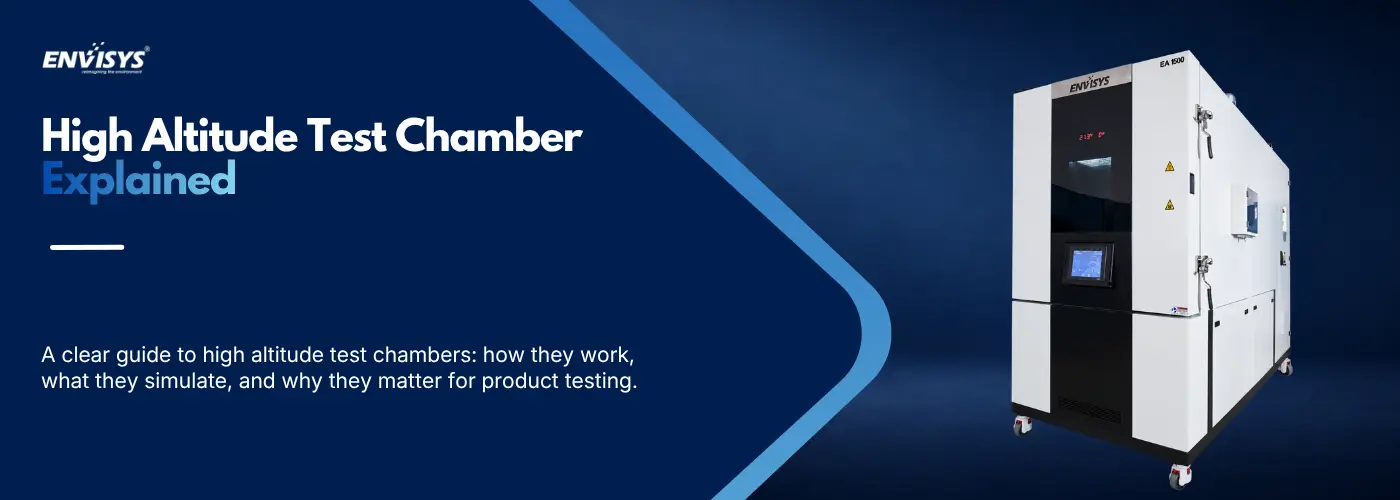
A high altitude test chamber is a sealed, reinforced enclosure connected to a vacuum pump and a control system. The pump removes air until internal pressure matches the altitude you programmed, and the controller holds it there for as long as the test requires.
You will hear the same equipment called a low pressure test chamber or a vacuum altitude chamber. One name describes the condition, the other the method.
Most units also control temperature, because altitude rarely arrives on its own. At 12,000 metres the outside air is near minus 55°C, so a chamber that only drops pressure will not reproduce what the product meets. Combined control is the normal specification for aerospace and battery work.
How a High Altitude Test Chamber Works
The specimen goes in fixtured so it sits clear of the walls. Thermocouples and any power or signal cables pass through sealed feedthroughs in the chamber wall, so the product can be powered and monitored while the test runs.
The door is sealed and the pump pulls air out, with the controller managing the rate of descent, because how fast pressure falls matters as much as where it ends up. A slow ramp lets trapped air escape gradually. A fast one stresses seals and enclosures, which is sometimes the point.
Once at setpoint, the chamber holds, and temperature is brought to its own setpoint if the profile calls for it. The specimen sits there for the specified soak, often six hours or more, while sensors log pressure and temperature throughout.
At the end the chamber vents back to ambient at a controlled rate, and the specimen is inspected and usually function tested. The recorded data becomes the test report.
What Conditions Can Be Simulated?
Altitude is the obvious one. Chambers are specified by the highest altitude they reach, and common working points include 2,438 metres for cabin conditions, 15,240 metres for battery transport, and 30,000 metres or beyond for aerospace equipment.
Temperature comes next, alone or alongside altitude. Combined profiles produce most of the useful findings, since a component that passes cold at sea level and altitude at room temperature can still fail when both arrive together.
Rapid decompression is a distinct test. Pressure drops very quickly, often in fifteen seconds or less, to represent a cabin losing pressurisation, and equipment has to survive without rupturing or throwing debris. Explosive decompression is a more severe version used for equipment near the pressure boundary.
Some chambers add humidity control at reduced pressure, and some let the specimen run under electrical load throughout, which is the only way to see the cooling effects described earlier.
Products Commonly Tested in a High Altitude Chamber
Lithium batteries and packs are the most common, since transport rules require it. Electronic assemblies follow: controllers, power supplies, radios, displays and sensors.
Aerospace parts of nearly every kind get tested, from avionics boxes to cabin fittings, seals, valves and fluid lines. Automotive electronics increasingly go through it too, partly for high–altitude export markets and partly because the same parts travel by air.
Packaging is tested to check that sealed pouches, bottles and blister packs survive a flight without bursting. Medical devices carried to remote clinics are qualified the same way, as are optical assemblies, where a little outgassing can fog a lens.
Industries That Depend on High Altitude Testing
Aerospace and aviation are the heaviest users, since almost nothing goes on an aircraft without altitude qualification. Defence follows, covering equipment carried by air or used in mountain deployments.
Battery and EV manufacturers use altitude testing for transport certification and for understanding cell behaviour under reduced pressure. Electronics manufacturers use it for thermal design validation and for export markets at elevation.
Automotive suppliers, medical device makers, packaging companies and telecom manufacturers all use it, generally to satisfy a customer specification or a regulation.
Important Standards for High Altitude Testing
Four documents cover most of the ground.
MIL–STD–810 Method 500 is the defence standard for low pressure, defining storage, operational and rapid decompression procedures. It is widely cited outside defence too.
RTCA DO–160 Section 4 covers temperature and altitude for airborne equipment, including decompression and overpressure procedures. If your product goes into a commercial aircraft, this is usually the one that matters.
IEC 60068-2-13, known as Test M, is the international standard for low air pressure testing. It is more general than the two above and is common for industrial and consumer electronics.
UN 38.3 Test 1 governs lithium battery transport. It requires 11.6 kPa, roughly 15,000 metres, held for at least six hours at ambient temperature. No cell or battery ships by air without passing it.
Sector documents sit alongside these, including ASTM D6653 for packaging and OEM specifications that are often stricter.
How to Choose the Right High Altitude Test Chamber
Start with the standard your customer cites, not with the catalogue. Pull the actual numbers out of it: the pressure to be reached, the ramp rate, the soak time, and whether temperature runs at the same time.
Then check the specimen. Measure it with its fixture and cabling, add clearance, and count the instrumentation channels that must pass through the wall, since retrofitting feedthroughs later is awkward and expensive.
Decide whether the specimen needs to be powered during the test. If so, the chamber needs the right feedthroughs and enough cooling capacity for the heat it puts out, which is harder under vacuum than at ambient.
Then compare suppliers on the technical response rather than the price sheet. Ask about lead time, commissioning and calibration, and where the nearest service engineer is. Envisys Technologies builds altitude test chambers to specification for aerospace, defence, battery and electronics work, designing the chamber around the specimen rather than the other way round.
Key Features to Look For In a High Altitude Test Chamber
Programmable multi–step control, so a profile combining altitude, ramp rate, temperature and hold time runs identically every time it is called.
Verified pressure and temperature performance across the full range, not just at the extremes. Ask for uniformity figures and pump–down time with a realistic load inside.
Good sealing, with a stated leak rate expressed as pressure rise over time. Door seals should be a standard replaceable part rather than something custom.
Safety systems: door interlocks that prevent opening under vacuum, controlled venting, over–temperature cutouts independent of the controller, and, for battery work, gas detection and an exhaust route that does not empty into the lab.
Data logging that records pressure, chamber temperature and specimen channels with timestamps, exports to a format you can still open in five years, and reports the actual profile against the target.
Remote monitoring, which matters more than it sounds. Altitude soaks often run overnight, and being able to check a test from home beats losing a full cycle to a fault at 3 a.m.
Conclusion
High altitude simulation testing exists because thin air breaks things in ways sea–level testing never reveals: heat that will not leave, seals that push outward, insulation gaps that arc. Finding those failures in a chamber costs far less than finding them in service.
If you are specifying altitude testing equipment, work backwards from the standard you have to satisfy, size for the specimen you will actually test, and treat service and calibration as part of the purchase. Those choices decide whether the chamber is still earning its place ten years from now.
FAQS
- What is a high altitude test chamber used for?
It reproduces the low air pressure found at altitude so you can see how a product behaves before it gets there. Typical uses include qualifying avionics and defence equipment, certifying lithium batteries for air transport, checking that sealed packaging survives a flight, and finding thermal problems in equipment that loses convective cooling.
- What industries use high altitude testing?
Aerospace and aviation are the largest users, followed by defence. Battery and EV manufacturers use it for transport certification, and electronics, automotive, medical, packaging and telecom manufacturers use it to meet customer specifications or qualify products for high- elevation markets.
- What is the difference between altitude testing and vacuum testing?
Altitude testing is a subset of vacuum testing with a specific purpose. It works in the mild vacuum range, roughly down to 1 mbar, and the goal is to reproduce a real altitude a product will encounter. General vacuum testing goes much deeper, often below 0.001 mbar, and is used for space simulation and outgassing work where the aim is to study material behaviour rather than replicate a place on Earth.
- What altitude can a high altitude test chamber simulate?
It depends on the chamber. Units built for cabin and transport work typically reach around 15,000 metres, enough for UN 38.3 battery testing. Chambers for aerospace and near–space work reach 30,000 metres and higher. Match the range to your standard, since deeper capability adds cost you may not need.

